SUBJECT FILE NO. IJM-0013
CLASSIFICATION: HISTORICAL ARCHIVE
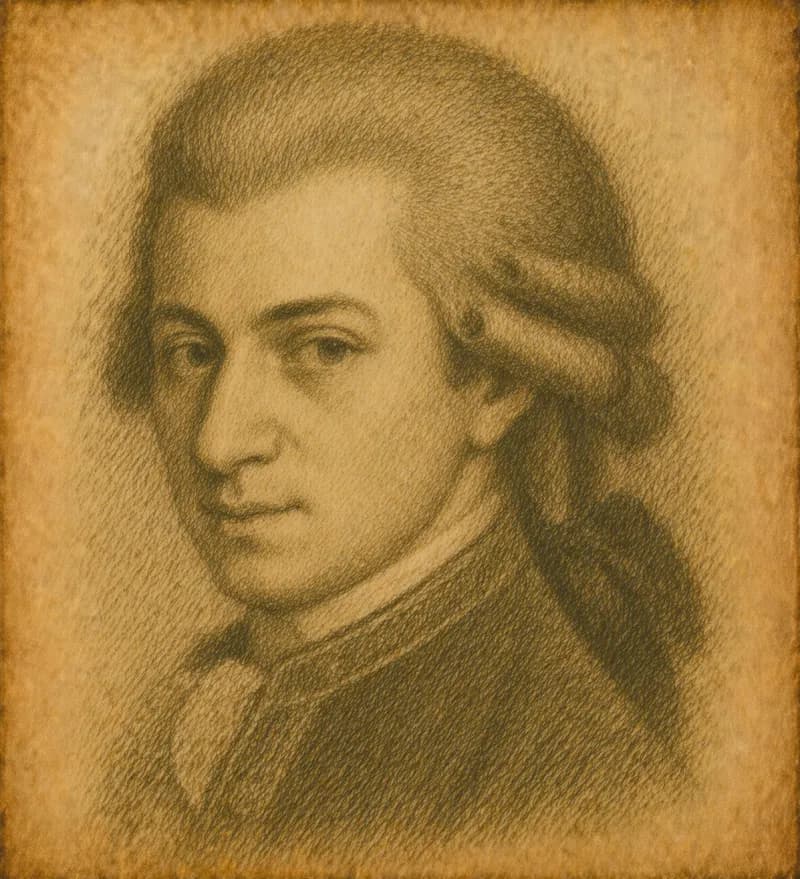
Wolfgang Amadeus Mozart
Wolfgang Amadeus Mozart
Composer
SECTION I -- SUBJECT PROFILE
| Name | Wolfgang Amadeus Mozart |
|---|---|
| English | Wolfgang Amadeus Mozart |
| Nationality | Austria |
| Lifespan | 1756–1791 |
| Gender | Male |
| Century | 16th–18th C. |
| Field | Music |
| Title | Composer |
SECTION II -- OVERVIEW
Wolfgang Amadeus Mozart was born in 1756 in Salzburg, Austria, the youngest surviving child of Leopold Mozart, a violinist and composer in the service of the Prince-Archbishop.From the cradle he was surrounded by music, listening as his older sister Nannerl practiced the harpsichord.
By three he was picking out thirds on the keyboard, by five he had composed his first little minuets, and his father, recognizing the miracle before him, began to record every piece.The first turning point came at age six, when Leopold took Wolfgang and Nannerl on a grand tour of European courts.
For the next decade the family traveled from Munich and Vienna to Paris, London, and Rome, where the young prodigy performed for Empress Maria Theresa, played blindfolded for Louis XV, and once transcribed Allegri's Miserere from memory after a single hearing at the Vatican.These travels exposed him to the Italian opera, French keyboard tradition, and Mannheim symphonic style that he would later synthesize into a universal musical language.
As a young man he chafed under the narrow patronage of the Salzburg archbishop, and the second turning point came in 1781 when he broke decisively with his employer and moved to Vienna to live as an independent musician, a radical step in an age of aristocratic patronage.Pioneering the life of the freelance composer, he poured out an astonishing flood of works: the revolutionary operas The Marriage of Figaro, Don Giovanni, and The Magic Flute, forty-one numbered symphonies, twenty-seven piano concertos that redefined the form, and an immense body of chamber music and sacred works.
Yet despite his genius he was perpetually short of money, and his health declined.In December 1791, while completing the Requiem commissioned anonymously by a mysterious stranger, he died in Vienna at the age of thirty-five, the requiem unfinished.
He was buried in a common grave.More than six hundred works survive, a towering summit of classical style that continues to stand at the center of Western music.
SECTION III -- CHRONOLOGY
SECTION IV -- NOTABLE STATEMENTS
“The music is not in the notes, but in the silence between.”
“Neither a lofty degree of intelligence nor imagination nor both together go to the making of genius.”
SECTION V -- FIELD NOTES
[A]Composing at age five
Mozart composed his first piece at the age of five and was reportedly able to replay complex compositions perfectly after hearing them just once. His prodigious memory and musical talent astonished everyone around him from early childhood.
SECTION VI -- LEGACY & IMPACT
Mozart's music set the standard for classical composition with its perfect balance of form, melody, and emotional depth. His operas transformed the genre from aristocratic entertainment into profound human drama, and his influence on subsequent composers from Beethoven to Tchaikovsky is immeasurable. His works remain the most performed in the classical repertoire worldwide.
SECTION VII -- MAJOR WORKS
- [01]The Marriage of Figaro (1786)
- [02]Don Giovanni (1787)
- [03]The Magic Flute (1791)
- [04]Requiem in D minor, K.626 (1791, unfinished)
- [05]Symphony No. 41 'Jupiter' (1788)