SUBJECT FILE NO. IJM-0017
CLASSIFICATION: HISTORICAL ARCHIVE
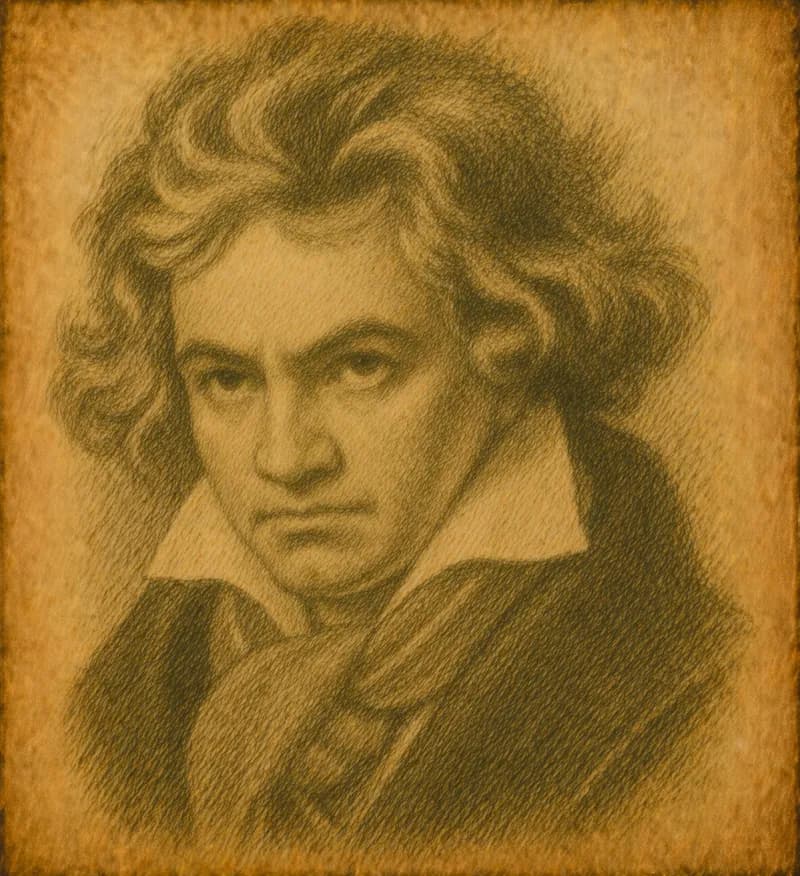
Ludwig van Beethoven
Ludwig van Beethoven
Composer & Pianist
SECTION I -- SUBJECT PROFILE
| Name | Ludwig van Beethoven |
|---|---|
| English | Ludwig van Beethoven |
| Nationality | Germany |
| Lifespan | 1770–1827 |
| Gender | Male |
| Century | 19th C. |
| Field | Music |
| Title | Composer & Pianist |
SECTION II -- OVERVIEW
Ludwig van Beethoven was born in 1770 in the Electoral city of Bonn on the Rhine, the son of a modestly talented court singer named Johann and the grandson of a respected musician who had been the city's Kapellmeister.His earliest years were darkened by his father's heavy drinking.
Hoping to produce a second Mozart from whom the family could profit, Johann would wake the small boy in the middle of the night to hammer at the keyboard, beating him if he played wrong notes.Yet Ludwig's love of music survived this brutality.
By eleven he was substituting at the court organ, by seventeen he traveled briefly to Vienna where he is said to have played for Mozart, and soon after he was responsible for supporting his younger brothers after his mother's death.The first turning point came in 1792, when the musical establishment of Bonn sent him to Vienna to study with Haydn, with a friend's famous farewell wish that he might 'receive Mozart's spirit from Haydn's hands.
' Brilliant at the keyboard, bold and unruly in manner, Beethoven conquered the Viennese aristocracy and became the most celebrated pianist-composer of his generation.Then, around 1798, in his late twenties, he noticed a ringing in his ears.
Within a few years his hearing was failing, an affliction unthinkable for a musician.The second and greatest turning point came in 1802 at the village of Heiligenstadt outside Vienna, where he drafted a despairing letter to his brothers, contemplating suicide, before resolving to live for his art.
From that crisis poured the Eroica Symphony, the Fifth, the Pastoral, the opera Fidelio, the late piano sonatas, and the string quartets that redefined the form.By the time he conducted the premiere of the Ninth Symphony in 1824, he was entirely deaf, turned by a singer to see the thunderous applause he could not hear.
He died in Vienna in 1827 at the age of fifty-six.The 'Ode to Joy' from his Ninth is now the anthem of Europe, a symbol of human solidarity.
SECTION III -- CHRONOLOGY
SECTION IV -- NOTABLE STATEMENTS
“Music is a higher revelation than all wisdom and philosophy.”
“I will seize fate by the throat; it shall certainly never wholly overcome me.”
SECTION V -- FIELD NOTES
[A]The applause he could not hear
At the premiere of his 9th Symphony, Beethoven was completely deaf. After the performance ended, he was unaware of the thunderous applause until a soloist turned him around to see the audience's overwhelming response.
SECTION VI -- LEGACY & IMPACT
Beethoven bridged the Classical and Romantic eras, expanding the scope and emotional range of the symphony, sonata, and concerto. His ability to compose masterworks after losing his hearing is one of the most remarkable achievements in the history of art. The Ninth Symphony's 'Ode to Joy' became the anthem of the European Union and a universal symbol of human brotherhood.
SECTION VII -- MAJOR WORKS
- [01]Symphony No. 9 'Choral' (1824)
- [02]Symphony No. 5 (1808)
- [03]Moonlight Sonata, Piano Sonata No. 14 (1801)
- [04]Fur Elise (c.1810)
- [05]Fidelio, opera (1805, revised 1814)