SUBJECT FILE NO. IJM-0033
CLASSIFICATION: HISTORICAL ARCHIVE
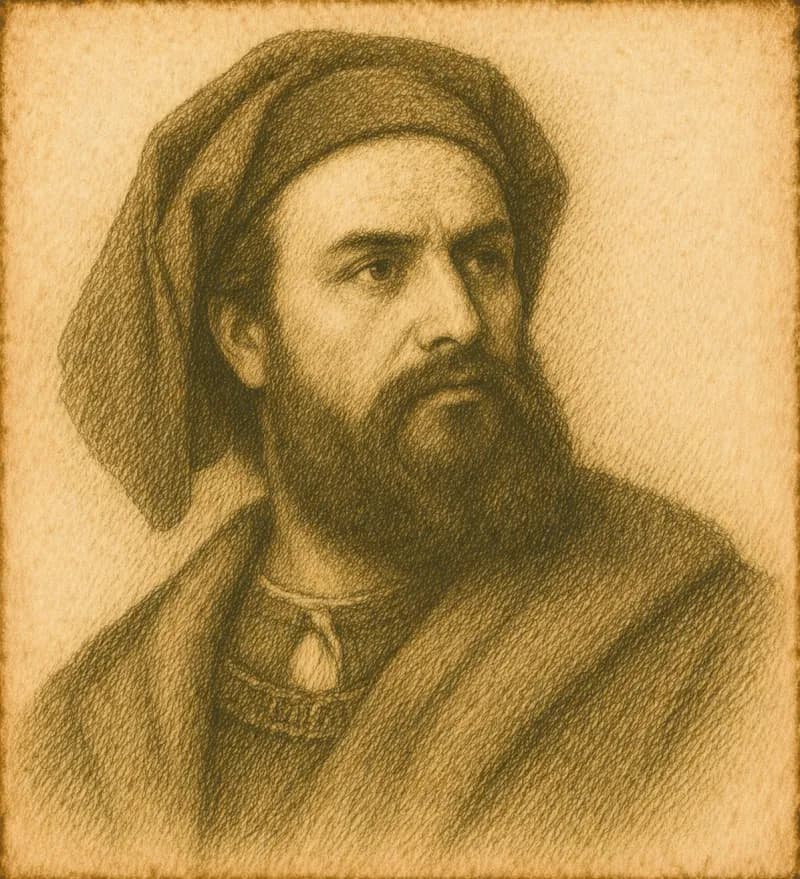
Marco Polo
Marco Polo
Explorer & Merchant
SECTION I -- SUBJECT PROFILE
| Name | Marco Polo |
|---|---|
| English | Marco Polo |
| Nationality | Italy |
| Lifespan | 1254–1324 |
| Gender | Male |
| Century | 11th–15th C. |
| Field | Exploration |
| Title | Explorer & Merchant |
SECTION II -- OVERVIEW
Marco Polo was born in 1254 into a family of Venetian merchants at the height of the Republic's maritime power, but he grew up without his father.His father Niccolò and uncle Maffeo had left on a trading journey to Constantinople before he was born, and pressed eastward from there across the steppes of Central Asia.
His mother died while they were away, and Marco was raised by relatives, learning Latin, the weighing of goods, and the ways of the sea.He was fifteen or so when his father and uncle finally returned to Venice, bringing tales of the court of the Mongol Great Khan Kublai and a letter from the Khan himself asking the Pope to send scholars.
The first turning point came in 1271, when the seventeen-year-old Marco, his father, and his uncle set out for the Mongol court, this time with a letter from Pope Gregory X and a flask of holy oil from Jerusalem.Their journey along the Silk Road was an epic of endurance, crossing Armenia, Persia, the Pamirs, and the blazing Gobi Desert until, three and a half years later in 1275, they arrived at Kublai's summer capital of Xanadu.
The second turning point came when the young Venetian charmed the aging Khan with his gift for languages and his sharp eye for detail.For the next seventeen years Marco served Kublai as a kind of roving envoy, traveling to Hangzhou, Yangzhou, Yunnan, and possibly Burma, and marveling at paper money, coal, the postal relay system, and mechanical clocks unknown to Europe.
In 1292 the Polos accompanied a Mongol princess by sea to Persia and eventually returned to Venice in 1295, laden with jewels.A few years later, captured during a sea battle with Genoa, Marco dictated his adventures to a fellow prisoner, Rustichello of Pisa.
The resulting book, known in Italian as Il Milione and in English as The Travels of Marco Polo, spread across Europe in manuscript and inflamed the imagination of an age.Christopher Columbus carried a copy on his own voyage.
Polo died in Venice in 1324 at seventy.
SECTION III -- CHRONOLOGY
SECTION IV -- NOTABLE STATEMENTS
“I did not tell half of what I saw.”
SECTION V -- FIELD NOTES
[A]His deathbed reply
On his deathbed, when urged to retract his「exaggerations」, Marco Polo famously replied: 「I did not tell half of what I saw.」
SECTION VI -- LEGACY & IMPACT
Marco Polo's account of his travels opened European eyes to the wealth and sophistication of Asian civilizations, fueling the desire for trade and exploration that led to the Age of Discovery. Christopher Columbus carried a copy of his book on his voyage to the Americas. His descriptions of paper money, coal, and postal systems introduced Europeans to innovations they had never imagined.
SECTION VII -- MAJOR WORKS
- [01]Il Milione / The Travels of Marco Polo (dictated 1298)
- [02]Descriptions of the Mongol Empire under Kublai Khan
- [03]First European account of Chinese paper currency
- [04]Documentation of Silk Road trade routes
- [05]Service to Kublai Khan as emissary (1275-1292)