SUBJECT FILE NO. IJM-0001
CLASSIFICATION: HISTORICAL ARCHIVE
Leonardo da Vinci
Leonardo da Vinci
Painter, Inventor, Scientist
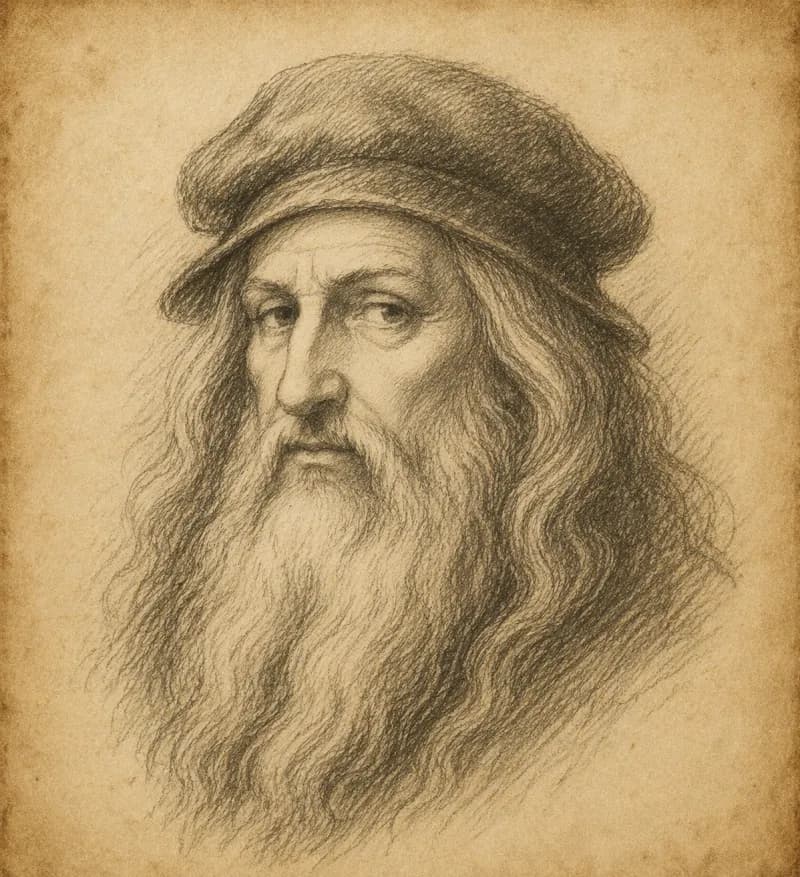
SECTION I -- SUBJECT PROFILE
| Name | Leonardo da Vinci |
|---|---|
| English | Leonardo da Vinci |
| Nationality | Italy |
| Lifespan | 1452–1519 |
| Gender | Male |
| Century | 16th–18th C. |
| Field | Art |
| Title | Painter, Inventor, Scientist |
SECTION II -- OVERVIEW
Leonardo da Vinci was born in 1452 in the small Tuscan town of Vinci, the illegitimate son of a notary and a peasant woman.Raised in modest circumstances without access to formal Latin schooling, he spent his boyhood in the Tuscan countryside, captivated by the flight of birds, the spiral of water, and the folds of drapery with an intensity that foreshadowed his genius.
The first turning point came at the age of fourteen, when his father apprenticed him to the renowned Florentine workshop of Andrea del Verrocchio.There Leonardo learned not only painting but sculpture, metalworking, and mechanical engineering, absorbing the skills that would define his boundless approach to knowledge.
After completing his apprenticeship, he entered the service of Ludovico Sforza in Milan as a military engineer, architect, and court painter, producing The Last Supper for the refectory of Santa Maria delle Grazie.His second, defining turning point was the realization that art and science could not be separated.
He dissected dozens of human corpses to produce anatomical drawings of unprecedented accuracy, studied the aerodynamics of bird wings to design flying machines, and filled thousands of mirror-written notebook pages with sketches centuries ahead of their time, from parachutes to armored vehicles.In his middle years he continued work on the Mona Lisa, whose elusive smile would make her the most famous portrait in the world.
Invited to France by King Francis I in 1516, Leonardo spent his final years in quiet companionship with the young king at the Château du Clos Lucé, and died in Amboise in 1519 at the age of sixty-seven.His legacy reaches far beyond the Renaissance: his anatomical studies advanced medicine by centuries, his engineering notebooks inspired modern inventors, and his fusion of art and inquiry established the ideal of the universal mind.
Leonardo remains the enduring symbol of human creativity and insatiable curiosity, proof that a single lifetime of patient observation can transform how we see the world.
SECTION III -- CHRONOLOGY
SECTION IV -- NOTABLE STATEMENTS
“Anyone who stops learning is old, whether at twenty or eighty.”
“Simplicity is the ultimate sophistication.”
SECTION V -- FIELD NOTES
[A]Mirror writing with the left hand
Da Vinci's manuscripts are famous for being written right-to-left in mirror script. Being left-handed, he reportedly adopted this to prevent ink smearing, though it may also have served to keep his notes secret.
[B]A vegetarian genius
Out of deep compassion for animals, he avoided eating meat and was known to buy caged birds at the market just to set them free—an extremely rare stance for his era.
SECTION VI -- LEGACY & IMPACT
Da Vinci's fusion of art and science laid the groundwork for the Renaissance ideal of the universal man. His anatomical drawings advanced medical knowledge by centuries, and the Mona Lisa remains the most recognized painting in the world.
SECTION VII -- MAJOR WORKS
- [01]Mona Lisa (c.1503-1519)
- [02]The Last Supper (1495-1498)
- [03]Vitruvian Man (c.1490)
- [04]Codex Leicester (scientific notebook)
- [05]Design for a flying machine (c.1488)