SUBJECT FILE NO. IJM-0008
CLASSIFICATION: HISTORICAL ARCHIVE
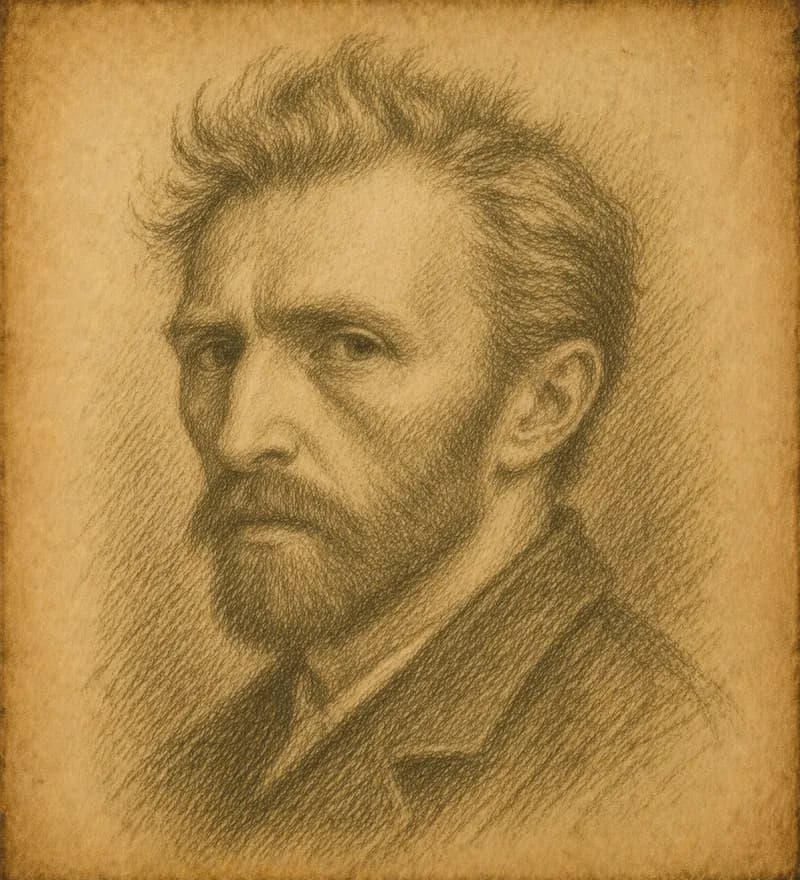
Vincent van Gogh
Vincent van Gogh
Post-Impressionist Painter
SECTION I -- SUBJECT PROFILE
| Name | Vincent van Gogh |
|---|---|
| English | Vincent van Gogh |
| Nationality | Netherlands |
| Lifespan | 1853–1890 |
| Gender | Male |
| Century | 19th C. |
| Field | Art |
| Title | Post-Impressionist Painter |
SECTION II -- OVERVIEW
Vincent van Gogh was born in 1853 in the Dutch village of Zundert, the son of a stern Protestant pastor and a mother who drew flowers and landscapes in her spare time.A sensitive, introverted child, he grew up wandering the fields of Brabant with his beloved younger brother Theo, forming the bond that would later sustain him through everything.
At sixteen, he began work as an art dealer at the Goupil gallery, passing through branches in The Hague, London, and Paris, and for a time seemed destined for a respectable bourgeois career.The first turning point was a descent into evangelical fervor.
After being dismissed from the gallery, he became a lay preacher in the poverty-stricken Borinage coalfields of Belgium, giving away his clothes and food to the miners until the church authorities relieved him of duty for excessive zeal.At twenty-seven, destitute and uncertain, he decided that he would become a painter.
Supported financially and emotionally by Theo, he taught himself drawing and painting with ferocious intensity, producing his early masterpiece The Potato Eaters, a dark and compassionate portrait of peasant life.The second turning point came in 1886 when he moved to Paris and encountered Impressionism and Japanese woodblock prints.
His palette exploded into vibrant yellows, blues, and greens.In 1888 he settled in Arles in the south of France, dreaming of founding a 'studio of the south,' and in a burst of productivity painted Sunflowers, The Bedroom, and the cafe scenes that defined him.
But his fragile mental health shattered during a disastrous stay with Paul Gauguin, during which he severed part of his own ear.Committed voluntarily to the Saint-Paul asylum at Saint-Rémy, he painted The Starry Night as he gazed out the window.
After a brief return to productivity in Auvers-sur-Oise, he died of a gunshot wound in July 1890 at the age of thirty-seven, having sold only a single painting in his lifetime.Today his work is among the most beloved in all of art.
SECTION III -- CHRONOLOGY
SECTION IV -- NOTABLE STATEMENTS
“Do not look for a beautiful landscape—find beauty in the landscape before you.”
“I want to express something comforting in my paintings, like music.”
SECTION V -- FIELD NOTES
[A]Only one painting sold in his lifetime
He created over 2,000 works in his lifetime, yet the only confirmed sale during his life was The Red Vineyard. Today, individual works fetch tens of millions of dollars.
SECTION VI -- LEGACY & IMPACT
Van Gogh's bold use of color and emotional intensity revolutionized Post-Impressionism and profoundly influenced Expressionism and modern art. Though he sold only one painting in his lifetime, his works now rank among the most expensive ever sold, and his story of artistic perseverance in the face of mental illness continues to inspire artists worldwide.
SECTION VII -- MAJOR WORKS
- [01]The Starry Night (1889)
- [02]Sunflowers series (1888-1889)
- [03]The Bedroom (1888)
- [04]Self-Portrait with Bandaged Ear (1889)
- [05]Wheatfield with Crows (1890)