SUBJECT FILE NO. IJM-0019
CLASSIFICATION: HISTORICAL ARCHIVE
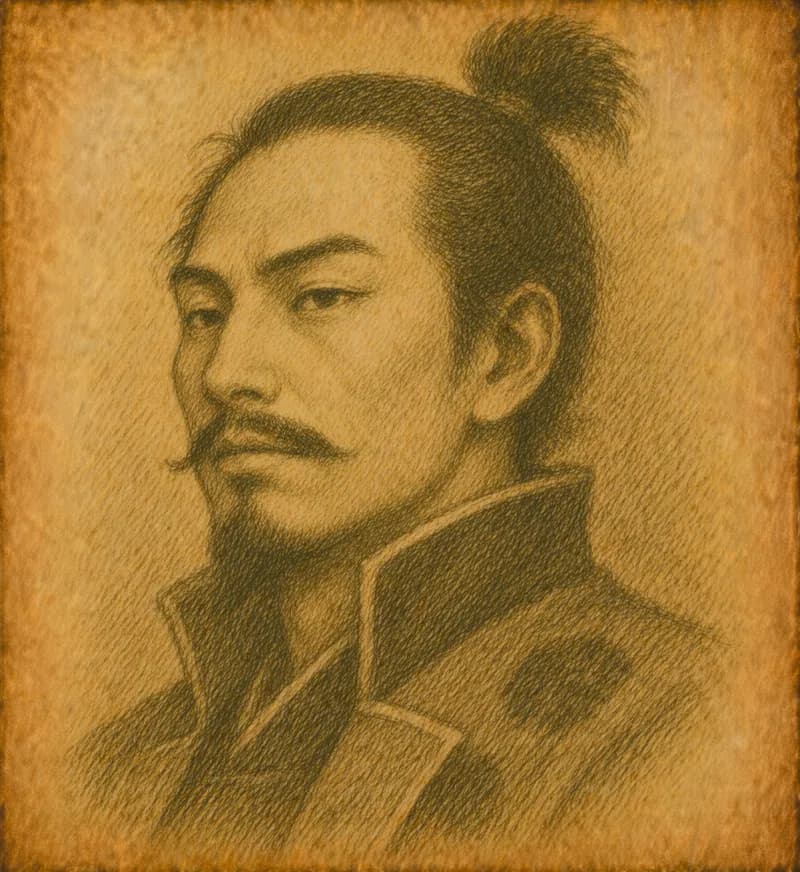
Oda Nobunaga
Oda Nobunaga
Warlord & Unifier of Japan
SECTION I -- SUBJECT PROFILE
| Name | Oda Nobunaga |
|---|---|
| English | Oda Nobunaga |
| Nationality | Japan |
| Lifespan | 1534–1582 |
| Gender | Male |
| Century | 16th–18th C. |
| Field | Military |
| Title | Warlord & Unifier of Japan |
SECTION II -- OVERVIEW
Oda Nobunaga was born in 1534 in Owari province, in what is now Aichi Prefecture, as the son of the modestly powerful warlord Oda Nobuhide.Japan was then in the Sengoku, or Warring States, period, a century of chaos during which the country had fractured into dozens of feuding domains.
As a boy Nobunaga cut an alarming figure.He dressed eccentrically, roamed the streets with commoners and fishermen, and showed no interest in court ritual, earning him the cutting nickname 'the Great Fool of Owari.
' At his father's funeral he is said to have hurled incense at the altar and stormed out, prompting his devoted retainer Hirate Masahide to commit ritual suicide in remonstrance.Yet behind the mask, the young lord was studying soldiers, trade, and the new firearms recently introduced by Portuguese traders.
The first turning point came in 1560 at the Battle of Okehazama.The powerful warlord Imagawa Yoshimoto advanced on Owari with some twenty-five thousand troops.Nobunaga, outnumbered roughly ten to one, struck their encamped main force during a thunderstorm with about two thousand men and killed Yoshimoto himself.
Overnight, the Fool of Owari became a name feared throughout the realm.He marched on Kyoto in 1568 to install the shogun Ashikaga Yoshiaki, then systematically crushed rivals from the Azai and Asakura to the militant Buddhist fortress of Mount Hiei, which he burned to the ground.
The second turning point came at Nagashino in 1575, where he arrayed three thousand matchlock arquebusiers behind wooden palisades and shattered the legendary Takeda cavalry, revolutionizing Japanese warfare.At his magnificent Azuchi Castle on Lake Biwa he welcomed Jesuit missionaries, abolished internal toll barriers, and proclaimed free-market policies under his 'rakuichi rakuza' edicts.
But in 1582, on the verge of national unification, he was betrayed by his general Akechi Mitsuhide and forced to commit suicide as Honnō-ji temple burned around him.The unification he began was completed by Toyotomi Hideyoshi and Tokugawa Ieyasu.
SECTION III -- CHRONOLOGY
SECTION IV -- NOTABLE STATEMENTS
“If a bird does not sing, kill it.”
SECTION V -- FIELD NOTES
[A]The Fool of Owari
Called 'the Fool of Owari' in his youth for his eccentric behavior, Nobunaga shocked everyone by defeating an army ten times his size at the Battle of Okehazama.
SECTION VI -- LEGACY & IMPACT
Nobunaga ended a century of civil war in Japan by defeating rival warlords and establishing centralized power, paving the way for the unification completed by his successors Hideyoshi and Tokugawa. His revolutionary use of firearms, free-market policies, and meritocratic governance transformed Japanese society and laid the foundations of the early modern Japanese state.
SECTION VII -- MAJOR WORKS
- [01]Victory at the Battle of Okehazama (1560)
- [02]Introduction of mass firearms tactics at Nagashino (1575)
- [03]Construction of Azuchi Castle (1576)
- [04]Rakuichi-rakuza free market policy
- [05]Abolition of road tolls (sekisho) to promote trade