SUBJECT FILE NO. IJM-0005
CLASSIFICATION: HISTORICAL ARCHIVE
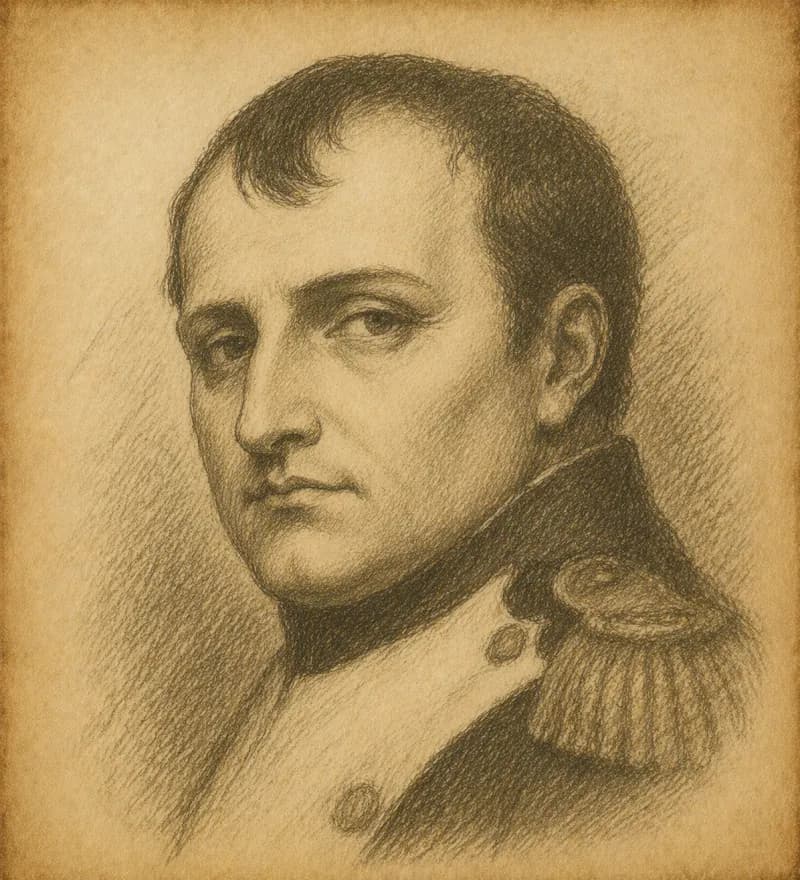
Napoleon Bonaparte
Napoleon Bonaparte
Emperor of France & Military Leader
SECTION I -- SUBJECT PROFILE
| Name | Napoleon Bonaparte |
|---|---|
| English | Napoleon Bonaparte |
| Nationality | France |
| Lifespan | 1769–1821 |
| Gender | Male |
| Century | 19th C. |
| Field | Military |
| Title | Emperor of France & Military Leader |
SECTION II -- OVERVIEW
Napoleon Bonaparte was born in 1769 on the island of Corsica, just one year after France annexed it from Genoa.The son of minor Italian-speaking nobles, he arrived at the mainland military school of Brienne at the age of nine, speaking French with a heavy Corsican accent that made him the butt of his classmates' mockery.
That humiliation drove him to bury himself in books on history, mathematics, and strategy.Commissioned as an artillery officer at sixteen, he was still a junior lieutenant when the French Revolution swept the country in 1789.
The first turning point came in 1793 at the Siege of Toulon, where royalist forces and the British fleet held the strategic port.The twenty-four-year-old captain seized a coastal battery by brilliant positioning, forced the enemy to evacuate, and was promoted to brigadier general overnight.
A series of stunning victories in Italy and a bold, if ultimately failed, campaign in Egypt made him France's most celebrated soldier.In 1799 he joined the coup of 18 Brumaire and became First Consul, and in 1804, in a ceremony at Notre-Dame, he crowned himself Emperor of the French.
His second turning point was the shattering victory at the Battle of Austerlitz in 1805, where he destroyed the combined armies of Austria and Russia and became master of continental Europe.During these years he promulgated the Napoleonic Code, a single, rationalized body of law that established equality before the law, property rights, and religious toleration, and which still underpins civil law in dozens of countries.
But the disastrous 1812 invasion of Russia cost him most of his Grand Army, and after a brief exile on Elba he returned for the Hundred Days only to be crushed at Waterloo in 1815.Banished to the remote island of Saint Helena, he died there in 1821 at fifty-one.
Remembered as both liberator and tyrant, Napoleon reshaped the map of Europe and accelerated the rise of the modern nation-state.
SECTION III -- CHRONOLOGY
SECTION IV -- NOTABLE STATEMENTS
“Impossible is a word found only in the dictionary of fools.”
SECTION V -- FIELD NOTES
[A]Was he really short?
The popular belief that Napoleon was short is a misconception born from differences between French and British measurement systems. His actual height was about 170 cm—average for a Frenchman of the time. British caricatures cemented the myth.
SECTION VI -- LEGACY & IMPACT
Napoleon's Napoleonic Code became the foundation of civil law in dozens of countries and remains influential today. His military campaigns reshaped the map of Europe, dismantled feudal structures, and spread the ideals of the French Revolution across the continent, accelerating the rise of nationalism and the modern nation-state.
SECTION VII -- MAJOR WORKS
- [01]Napoleonic Code (1804)
- [02]Battle of Austerlitz (1805)
- [03]Continental System (1806)
- [04]Reorganization of European borders at Tilsit (1807)
- [05]Establishment of the Bank of France (1800)