SUBJECT FILE NO. IJM-0030
CLASSIFICATION: HISTORICAL ARCHIVE
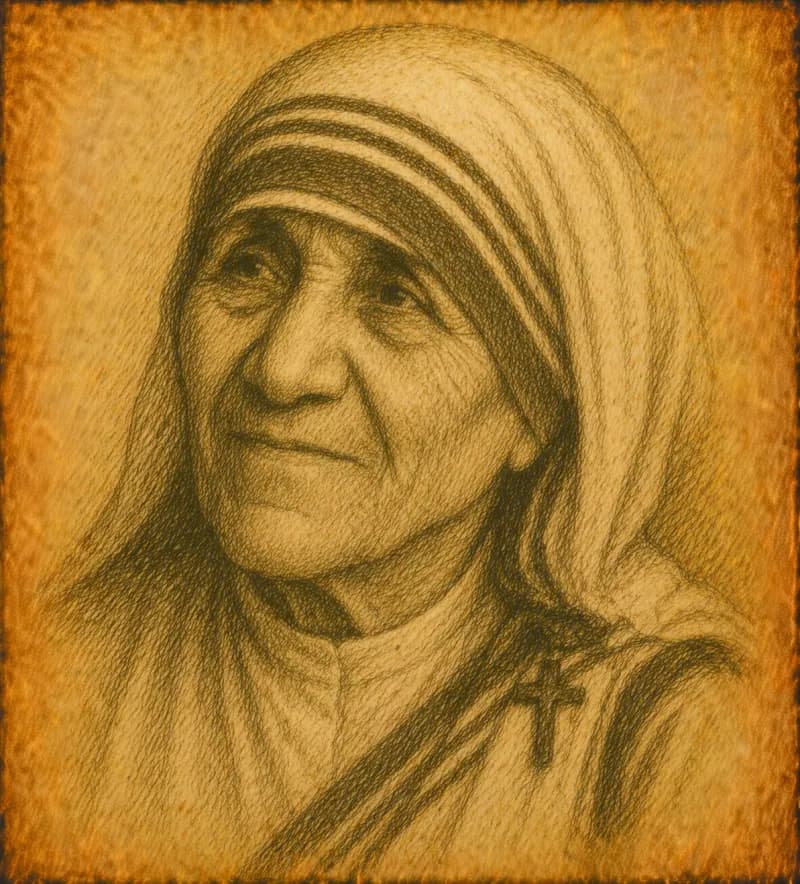
Mother Teresa
Mother Teresa
Nun & Humanitarian
SECTION I -- SUBJECT PROFILE
| Name | Mother Teresa |
|---|---|
| English | Mother Teresa |
| Nationality | India |
| Lifespan | 1910-1997 |
| Gender | Female |
| Century | 20th C. |
| Field | Medicine |
| Title | Nun & Humanitarian |
SECTION II -- OVERVIEW
Mother Teresa was born Anjezë Gonxhe Bojaxhiu in 1910 in Skopje, then part of the Ottoman Empire and now the capital of North Macedonia, into a prosperous Albanian Catholic family.She was the youngest of three children, and her father Nikollë was a successful merchant with strong Albanian patriotic convictions.
When she was only eight he died suddenly, probably poisoned for his political activities, plunging the family into near-poverty.Her mother Drana held them together with iron faith and constant charity, regularly inviting the hungry of Skopje to share their table and telling her children, 'Never eat a single mouthful unless you are sharing it with others.
' The first turning point came when Anjezë was twelve and felt a call to religious life, confirmed in her teens by her readings about the missions in Bengal.At eighteen she left her mother and sister forever, entered the Irish Loreto Sisters in Dublin to learn English, and within a year sailed for India.
Taking her final vows as Sister Teresa, named for Thérèse of Lisieux, she taught geography for nearly two decades at the girls' school of St.Mary's in Calcutta, eventually becoming its headmistress.
The second turning point came on September 10, 1946, during a train journey to Darjeeling, when she experienced what she would always call 'the call within the call,' a command to leave the convent and live among the poorest of the poor.After lengthy negotiations with church authorities, she exchanged her Loreto habit for a simple white sari with blue stripes and walked out into the slums of Calcutta in 1948.
In 1950 she founded the Missionaries of Charity, and soon opened Nirmal Hriday, the 'Home for the Dying,' where destitute people could die with dignity, along with orphanages and leprosy clinics.She received the Nobel Peace Prize in 1979 and asked that the banquet be canceled and its cost given to the poor.
By the time of her death in 1997 at eighty-seven, her order had spread to more than a hundred countries.She was canonized as Saint Teresa of Calcutta in 2016.
SECTION III -- CHRONOLOGY
SECTION IV -- NOTABLE STATEMENTS
“If you judge people, you have no time to love them.”
“Not all of us can do great things. But we can do small things with great love.”
SECTION V -- FIELD NOTES
[A]Born Anjeze Gonxhe Bojaxhiu
Born Anjeze Gonxhe Bojaxhiu in modern-day North Macedonia, she took the name Teresa after Therese of Lisieux, the patron saint of missionaries.
SECTION VI -- LEGACY & IMPACT
Mother Teresa brought global attention to the plight of the poorest and most marginalized people, establishing the Missionaries of Charity which now operates in over 130 countries. Her life of radical service challenged the world to confront poverty and suffering, and her canonization in 2016 cemented her legacy as one of the most admired humanitarian figures of the 20th century.
SECTION VII -- MAJOR WORKS
- [01]Founding of the Missionaries of Charity (1950)
- [02]Establishment of Nirmal Hriday (Home for the Dying, 1952)
- [03]Nobel Peace Prize (1979)
- [04]Expansion to 130+ countries with 4,500+ sisters
- [05]Canonization as Saint Teresa of Calcutta (2016)