SUBJECT FILE NO. IJM-0023
CLASSIFICATION: HISTORICAL ARCHIVE
Helen Keller
Helen Keller
Author & Activist
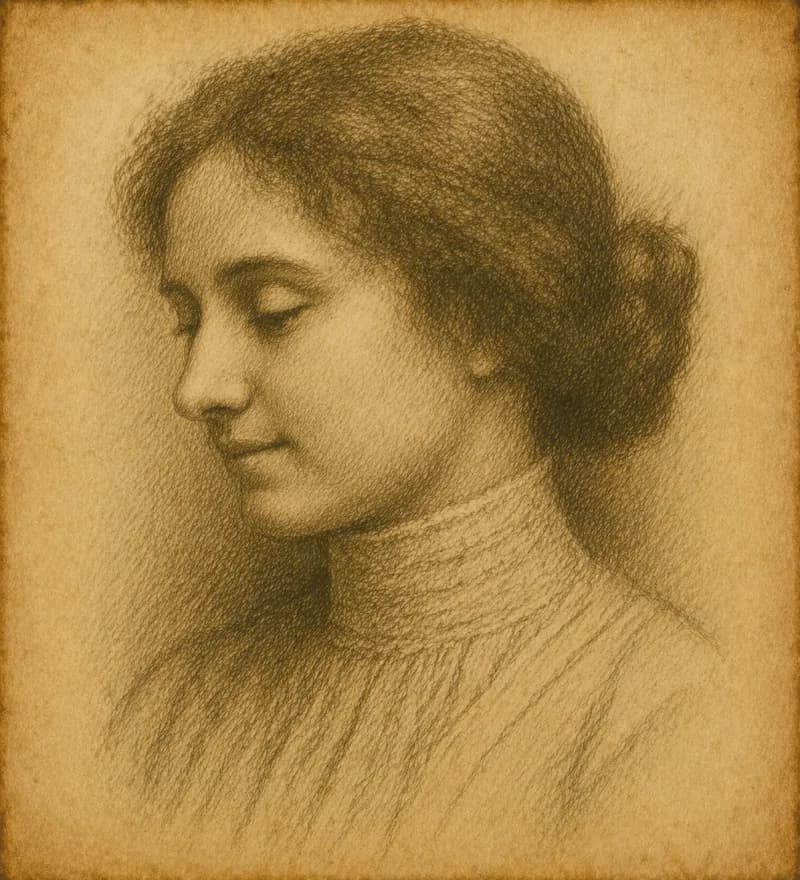
SECTION I -- SUBJECT PROFILE
| Name | Helen Keller |
|---|---|
| English | Helen Keller |
| Nationality | United States |
| Lifespan | 1880-1968 |
| Gender | Female |
| Century | 19th C. |
| Field | Literature |
| Title | Author & Activist |
SECTION II -- OVERVIEW
Helen Keller was born in 1880 on a cotton plantation near Tuscumbia in northern Alabama, the bright and lively daughter of a former Confederate officer turned newspaper editor.She was a normal toddler, walking and saying her first words, until at nineteen months a severe fever, possibly scarlet fever or meningitis, left her completely deaf and blind.
Suddenly locked in silent darkness, she became a furious, isolated little girl, communicating only through a few crude home-signs with her family and lashing out with violent tantrums when her needs could not be understood.The first and most famous turning point of her life came in March 1887, when her parents, on the advice of Alexander Graham Bell, hired a twenty-year-old partially blind teacher from the Perkins School for the Blind named Anne Sullivan.
Sullivan arrived at the Keller home and almost immediately began spelling words into Helen's hand with the manual alphabet.For weeks Helen played with the letters without understanding, until one morning Sullivan pumped cool water over one of her hands while spelling 'w-a-t-e-r' into the other.
In a flash of revelation, Helen grasped that everything in the world had a name.Within hours she had learned thirty words.From this single breakthrough came a remarkable education.
She mastered Braille, typed on a specially adapted typewriter, and learned to speak by feeling the vibrations of Sullivan's throat.She entered Radcliffe College and in 1904 graduated cum laude, becoming the first deafblind person to earn a college degree.
The second turning point came as she transformed her personal achievement into public advocacy.She wrote her bestselling autobiography The Story of My Life in 1903, became a lecturer around the world, helped found the American Civil Liberties Union in 1920, and campaigned for the American Foundation for the Blind, women's suffrage, labor rights, and pacifism.
Traveling to more than thirty-five countries, she met every American president from Grover Cleveland to Lyndon Johnson.She died in 1968 at the age of eighty-seven, an enduring symbol of what compassion and education can accomplish.
SECTION III -- CHRONOLOGY
SECTION IV -- NOTABLE STATEMENTS
“The best and most beautiful things in the world cannot be seen or even touched - they must be felt with the heart.”
“Alone we can do so little; together we can do so much.”
SECTION V -- FIELD NOTES
[A]The first word: water
Helen learned her first word when Sullivan spelled 'water' into her hand while running water over it. In that moment, she understood for the first time that things have names - a breakthrough that changed her life forever.
SECTION VI -- LEGACY & IMPACT
Keller proved that deafblindness need not prevent a person from achieving the highest intellectual and social accomplishments. Her advocacy transformed public attitudes toward disability and led to significant improvements in education and services for people with disabilities. She became a global symbol of perseverance and the transformative power of education.
SECTION VII -- MAJOR WORKS
- [01]The Story of My Life (1903)
- [02]The World I Live In (1908)
- [03]Co-founding of the American Civil Liberties Union (ACLU, 1920)
- [04]Advocacy work for the American Foundation for the Blind
- [05]Out of the Dark (1913)