SUBJECT FILE NO. IJM-0016
CLASSIFICATION: HISTORICAL ARCHIVE
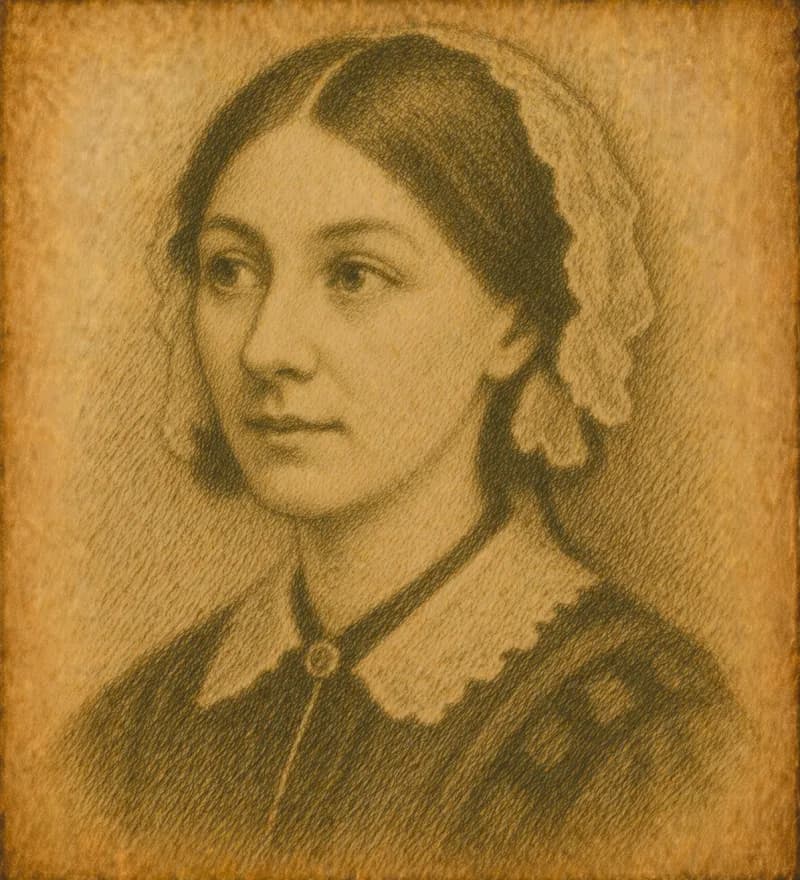
Florence Nightingale
Florence Nightingale
Nurse, Statistician & Social Reformer
SECTION I -- SUBJECT PROFILE
| Name | Florence Nightingale |
|---|---|
| English | Florence Nightingale |
| Nationality | United Kingdom |
| Lifespan | 1820–1910 |
| Gender | Female |
| Century | 19th C. |
| Field | Medicine |
| Title | Nurse, Statistician & Social Reformer |
SECTION II -- OVERVIEW
Florence Nightingale was born in 1820 into a wealthy and cultivated English family while they were on an extended tour of Italy, and was named for the city of her birth.Her father William, a progressive country gentleman, personally educated Florence and her elder sister Parthenope in mathematics, Italian, Greek, German, and philosophy, an education utterly unusual for Victorian women.
As she grew into young womanhood, her family expected her to marry well and to shine in London society.The first turning point came when she was seventeen.Walking in the gardens of her family's country estate, she experienced what she described as a call from God to serve humanity.
For the next decade she chafed against her family's refusal to let her pursue nursing, then considered a disreputable profession fit only for drunken women.At last, in her early thirties, she broke free and traveled to Germany to train at the Protestant nursing community of Kaiserswerth, then took charge of a small hospital for gentlewomen in London.
The second, history-changing turning point came in 1854 when news of appalling conditions in British army hospitals during the Crimean War reached London.Death rates in the military hospital at Scutari were catastrophic, with soldiers dying of typhus, cholera, and dysentery far more often than of their wounds.
Nightingale led a party of thirty-eight nurses to the Bosphorus, where she enforced ruthless standards of sanitation, ventilation, nutrition, and clean linen, and cut the hospital's death rate dramatically.Walking the wards at night with a lamp in hand, she became legendary as 'the Lady with the Lamp.
' Back in England she pioneered the use of statistics and polar area diagrams to persuade politicians that hygiene saves lives, established the world's first scientific nursing school at St.Thomas' Hospital in 1860, and reshaped British military medicine.
She died in London in 1910 at the age of ninety.Her birthday, May 12, is celebrated worldwide as International Nurses Day.
SECTION III -- CHRONOLOGY
SECTION IV -- NOTABLE STATEMENTS
“I attribute my success to this: I never gave or took any excuse.”
“How very little can be done under the spirit of fear.”
SECTION V -- FIELD NOTES
[A]The Lady with the Lamp
During the Crimean War, Nightingale made nightly rounds carrying a lamp to check on each patient. This image earned her the enduring nickname 'The Lady with the Lamp.'
SECTION VI -- LEGACY & IMPACT
Nightingale transformed nursing from a low-status occupation into a respected profession and pioneered the use of statistics in public health. Her insistence on sanitation and hygiene dramatically reduced hospital mortality rates and laid the groundwork for modern epidemiology. International Nurses Day is celebrated on her birthday, May 12.
SECTION VII -- MAJOR WORKS
- [01]Notes on Nursing (1859)
- [02]Establishment of the Nightingale Training School (1860)
- [03]Statistical diagrams on causes of mortality in the Crimean War
- [04]Notes on Hospitals (1863)
- [05]Reform of British Army medical services