SUBJECT FILE NO. IJM-0003
CLASSIFICATION: HISTORICAL ARCHIVE
Marie Curie
Marie Curie
Physicist & Chemist
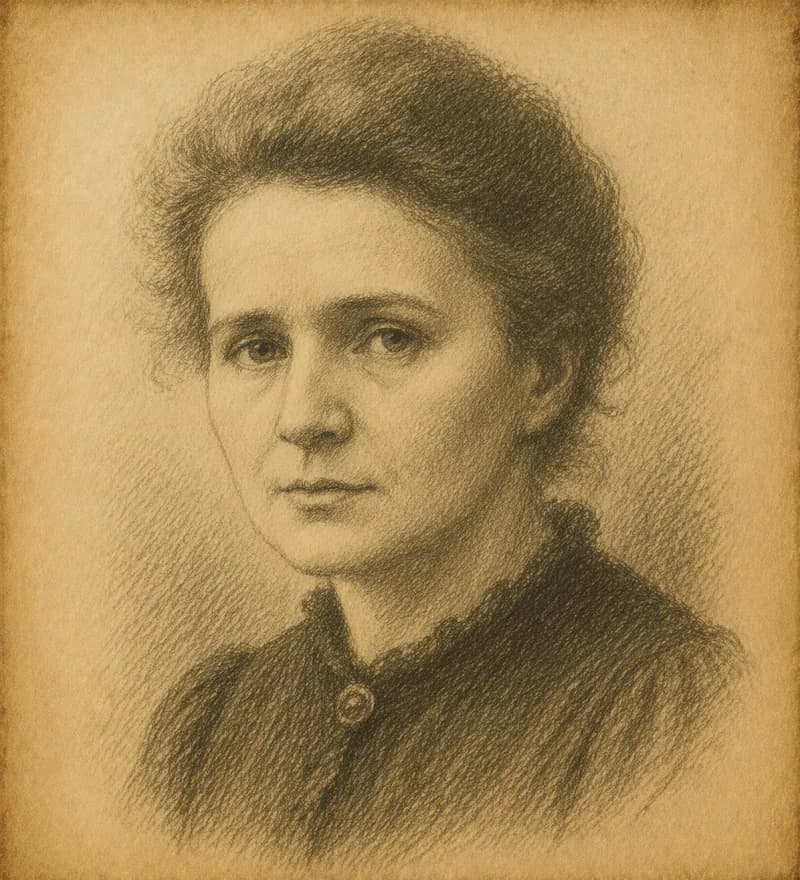
SECTION I -- SUBJECT PROFILE
| Name | Marie Curie |
|---|---|
| English | Marie Curie |
| Nationality | Poland |
| Lifespan | 1867–1934 |
| Gender | Female |
| Century | 19th C. |
| Field | Science |
| Title | Physicist & Chemist |
SECTION II -- OVERVIEW
Marie Curie was born Maria Skłodowska in 1867 in Warsaw, then under Russian imperial rule, where Polish culture was being systematically suppressed.Raised in a family of struggling schoolteachers, she lost her eldest sister to typhus and her mother to tuberculosis before she was eleven, hardships that shaped her into a disciplined and solitary child.
The first turning point came when Russian authorities barred women from university.Determined to study, Maria and her sister Bronisława made a pact: Maria would work as a governess to support Bronisława's medical studies in Paris, and her sister would later return the favor.
For five long years Maria tutored the children of wealthy families, reading physics in the scraps of spare time before finally arriving at the Sorbonne in 1891.Living in an unheated garret on bread and tea, she graduated first in her physics class and second in mathematics.
Her second turning point was her meeting with Pierre Curie, a quiet French physicist, whom she married in 1895.In a leaking shed behind the School of Physics, they worked together to isolate mysterious radiations emanating from uranium ore, and in 1898 they announced the discovery of two new elements: polonium, named after her homeland, and radium.
In 1903 she shared the Nobel Prize in Physics with Pierre and Henri Becquerel.The sudden death of Pierre in a street accident in 1906 was devastating, but she carried on alone, succeeding him at the Sorbonne as its first female professor and winning a second Nobel Prize in Chemistry in 1911 for isolating pure radium.
During World War I she personally drove mobile X-ray units to the front lines, saving thousands of soldiers.Years of radiation exposure ruined her health, and she died of aplastic anemia in 1934.
Her notebooks remain radioactive to this day, and her example continues to inspire generations of women in science.
SECTION III -- CHRONOLOGY
SECTION IV -- NOTABLE STATEMENTS
“Nothing in life is to be feared, it is only to be understood.”
SECTION V -- FIELD NOTES
[A]Notebooks still radioactive
Curie's research notebooks, now kept at the French National Library, still emit strong radiation over a century later. Viewing them requires lead-lined boxes and protective clothing.
SECTION VI -- LEGACY & IMPACT
Curie's discovery of radioactivity opened entirely new fields of physics and chemistry, and her techniques for isolating radioactive isotopes led directly to advances in cancer treatment. She shattered gender barriers in science, becoming the first woman to win a Nobel Prize and the only person to win in two different sciences.
SECTION VII -- MAJOR WORKS
- [01]Discovery of polonium (1898)
- [02]Discovery of radium (1898)
- [03]Nobel Prize in Physics (1903)
- [04]Nobel Prize in Chemistry (1911)
- [05]Development of mobile X-ray units in WWI