SUBJECT FILE NO. IJM-0009
CLASSIFICATION: HISTORICAL ARCHIVE
Isaac Newton
Isaac Newton
Physicist & Mathematician
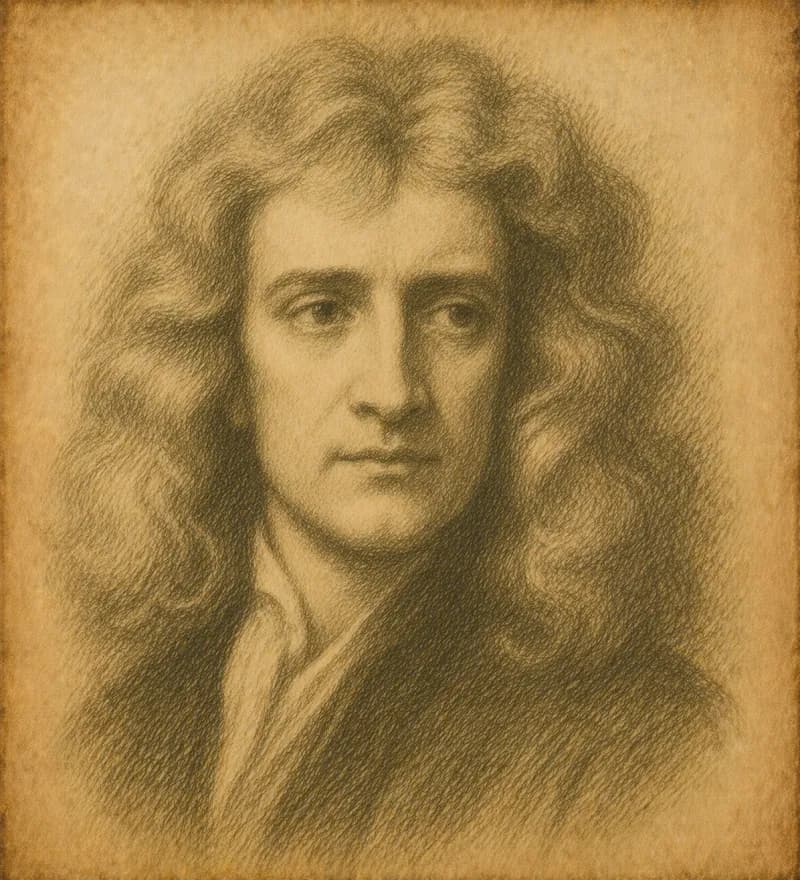
SECTION I -- SUBJECT PROFILE
| Name | Isaac Newton |
|---|---|
| English | Isaac Newton |
| Nationality | United Kingdom |
| Lifespan | 1643–1727 |
| Gender | Male |
| Century | 16th–18th C. |
| Field | Science |
| Title | Physicist & Mathematician |
SECTION II -- OVERVIEW
Isaac Newton was born prematurely on Christmas Day 1642 in the rural hamlet of Woolsthorpe in Lincolnshire, England.His father, an illiterate yeoman farmer, had died three months before his birth, and when the boy was three his mother remarried and left him to be raised by his grandmother.
That early abandonment left him solitary, intense, and quietly vengeful.As a schoolboy in Grantham he impressed no one with his grades but built ingenious wooden clocks, sundials, and a tiny working windmill powered by a mouse.
The first turning point came when his uncle, noticing his bookishness, persuaded his mother to let him return to school and then enter Trinity College, Cambridge, as a sizar, a poor scholar who paid for his studies by serving wealthier students.There he devoured the new philosophy of Descartes, Galileo, and Kepler.
Then came the plague of 1665, which closed the university and sent him home for eighteen months.That retreat to Woolsthorpe was the greatest turning point of his life, his so-called annus mirabilis.
In a single burst of thought he invented the calculus, decomposed white light into the colors of the spectrum with a prism, and conceived the idea that the same force pulling an apple toward the earth might also hold the moon in its orbit.For nearly twenty years he developed these insights privately, until his friend Edmond Halley coaxed him into publication.
In 1687 appeared the Principia, a mathematical edifice uniting the motions of heaven and earth under a single law of gravitation.In later life he served as Warden and Master of the Royal Mint, prosecuting counterfeiters with chilling efficiency, and as President of the Royal Society.
He also pursued alchemy and biblical chronology with obsessive secrecy.He died in London in 1727 at the age of eighty-four, was buried at Westminster Abbey, and left behind a scientific framework that governed physics for over two centuries.
SECTION III -- CHRONOLOGY
SECTION IV -- NOTABLE STATEMENTS
“If I have seen further, it is by standing on the shoulders of giants.”
“I am but a child playing on the seashore, while the vast ocean of truth lies undiscovered before me.”
SECTION V -- FIELD NOTES
[A]Did the apple really fall?
The story that an apple fell on Newton's head is exaggerated. Newton himself said he 'saw an apple fall from a tree and wondered why the Moon doesn't fall.' The insight was not a single moment but the culmination of over 20 years of thought.
SECTION VI -- LEGACY & IMPACT
Newton's laws of motion and universal gravitation unified terrestrial and celestial mechanics, forming the basis of classical physics for over two centuries. His development of calculus provided mathematics with one of its most powerful tools, and his work in optics revealed the nature of light. The Principia remains one of the most important scientific works ever written.
SECTION VII -- MAJOR WORKS
- [01]Philosophiae Naturalis Principia Mathematica (1687)
- [02]Law of Universal Gravitation
- [03]Three Laws of Motion
- [04]Development of calculus (independently of Leibniz)
- [05]Opticks (1704)