SUBJECT FILE NO. IJM-0002
CLASSIFICATION: HISTORICAL ARCHIVE
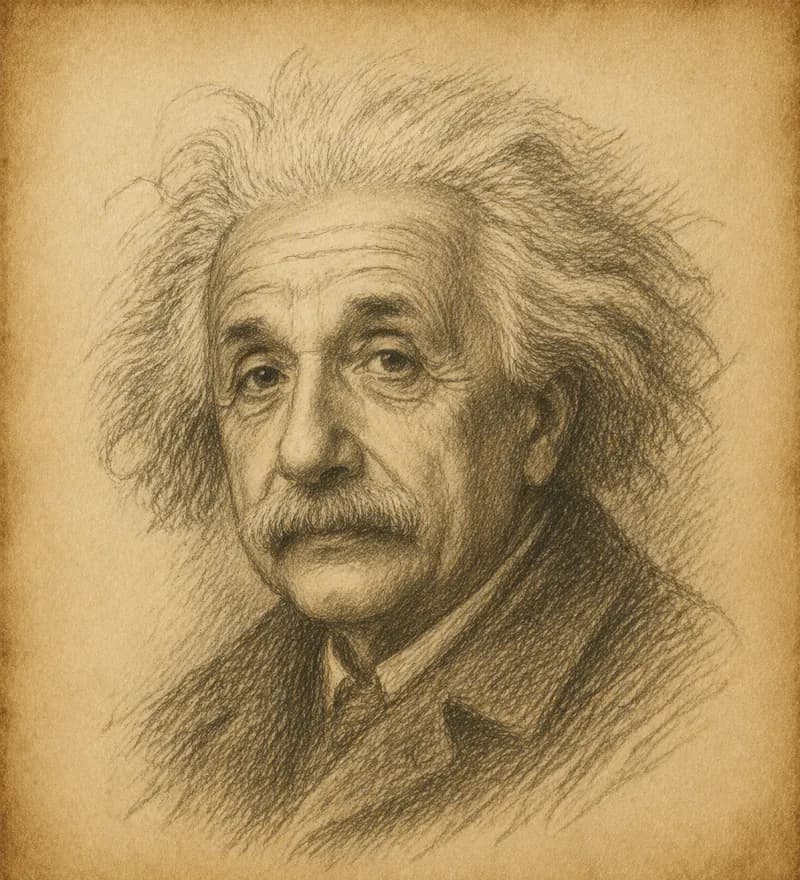
Albert Einstein
Albert Einstein
Theoretical Physicist
SECTION I -- SUBJECT PROFILE
| Name | Albert Einstein |
|---|---|
| English | Albert Einstein |
| Nationality | Germany |
| Lifespan | 1879–1955 |
| Gender | Male |
| Century | 20th C. |
| Field | Science |
| Title | Theoretical Physicist |
SECTION II -- OVERVIEW
Albert Einstein was born in 1879 in Ulm, in southern Germany, to a secular Jewish family that soon moved to Munich where his father ran an electrical business.As a small child he was slow to speak, and his parents worried that something might be wrong.
The first turning point came at the age of five, when his father showed him a pocket compass.The sight of the needle swinging under an invisible force left him astonished, planting a lifelong conviction that hidden laws governed the natural world.
A rebellious student who clashed with rigid teachers, he nevertheless excelled in mathematics and physics, eventually earning a diploma from the ETH in Zurich.Unable to secure an academic post, he took a modest job at the Swiss patent office in Bern, examining applications by day and pursuing physics on his own.
That apparent setback proved decisive.In 1905, his 'miracle year,' the unknown clerk published four revolutionary papers that introduced special relativity, the mass–energy equivalence E=mc², the quantum explanation of the photoelectric effect, and a theory of Brownian motion.
The second turning point came in 1915 with the completion of general relativity, which recast gravity as the curvature of space and time.When a 1919 solar eclipse confirmed his predictions, Einstein became a global celebrity, and in 1921 he received the Nobel Prize in Physics.
In 1933, with Hitler rising to power, he emigrated to the United States and joined the Institute for Advanced Study in Princeton.In his later years he became a passionate voice for pacifism, civil rights, and nuclear disarmament, though he famously agonized over the atomic weapons his physics had helped make possible.
He died in Princeton in 1955 at the age of seventy-six.His legacy extends from GPS satellites to gravitational-wave observatories, and his tousled hair and thoughtful gaze have become the universal image of scientific genius itself.
SECTION III -- CHRONOLOGY
SECTION IV -- NOTABLE STATEMENTS
“Imagination is more important than knowledge.”
“The important thing is not to stop questioning.”
SECTION V -- FIELD NOTES
[A]The failing-student myth
The story that Einstein failed math is false. He actually scored top marks in math and physics. However, his average grades in French and zoology gave rise to this urban legend.
SECTION VI -- LEGACY & IMPACT
Einstein's theories of relativity fundamentally changed our understanding of space, time, and energy. His equation E=mc2 became the foundation of nuclear physics, and his work continues to underpin modern technologies from GPS to gravitational wave detection.
SECTION VII -- MAJOR WORKS
- [01]Special Theory of Relativity (1905)
- [02]General Theory of Relativity (1915)
- [03]Photoelectric Effect (Nobel Prize 1921)
- [04]E=mc2 mass-energy equivalence
- [05]Einstein-Podolsky-Rosen paradox (1935)