SUBJECT FILE NO. IJM-0007
CLASSIFICATION: HISTORICAL ARCHIVE
Galileo Galilei
Galileo Galilei
Physicist & Astronomer
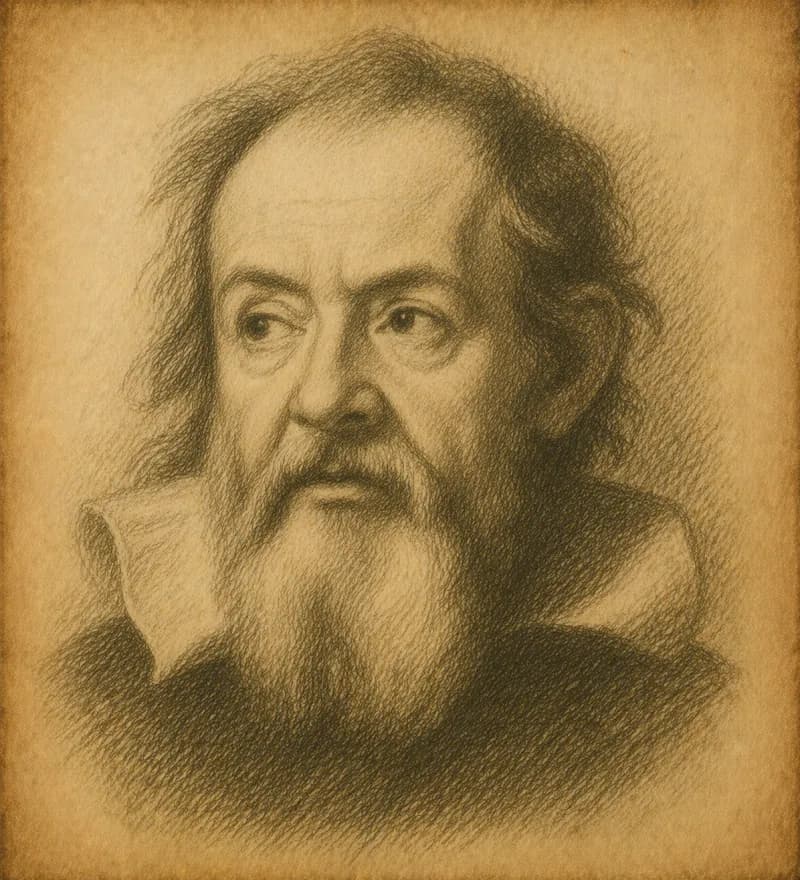
SECTION I -- SUBJECT PROFILE
| Name | Galileo Galilei |
|---|---|
| English | Galileo Galilei |
| Nationality | Italy |
| Lifespan | 1564–1642 |
| Gender | Male |
| Century | 16th–18th C. |
| Field | Science |
| Title | Physicist & Astronomer |
SECTION II -- OVERVIEW
Galileo Galilei was born in 1564 in Pisa, in the Grand Duchy of Tuscany, to a lute-playing musician and theorist of mathematical music, Vincenzo Galilei.The family valued learning and art in equal measure, and the young Galileo absorbed both a sensitivity to proportion and a skepticism toward received authority.
His father urged him to study medicine at the University of Pisa, the safer and more lucrative career path.The first turning point came during a service in the Pisa cathedral, where the young student noticed a swinging chandelier.
Timing its oscillations against his own pulse, he realized that the period did not depend on the amplitude of the swing, an observation that pulled him away from medicine toward mathematics and physics.By twenty-five he was a professor of mathematics at Pisa, conducting experiments with falling bodies that overturned the Aristotelian belief that heavier objects fall faster.
His life was transformed again in 1609, when news reached him from the Netherlands of a curious instrument that made distant objects appear close.Within months he had built his own, superior telescope and turned it to the night sky.
What he saw astonished Europe: mountains on the Moon, four moons orbiting Jupiter, the phases of Venus, and countless stars invisible to the naked eye.These observations provided the first empirical evidence for Copernicus's heliocentric model.
But the Catholic Church condemned the doctrine as heresy, and in 1633 the ageing Galileo was summoned before the Roman Inquisition, forced to his knees, and compelled to recant.Condemned to house arrest for the rest of his life at his villa in Arcetri, he refused to fall silent, secretly completing Two New Sciences, the founding text of modern mechanics.
He died in 1642, blind and confined, at seventy-seven.Rightly called the father of modern science, Galileo established observation and experiment as the path to truth and laid the foundation on which Newton would build.
SECTION III -- CHRONOLOGY
SECTION IV -- NOTABLE STATEMENTS
“And yet it moves.”
SECTION V -- FIELD NOTES
[A]The truth about the trial
The famous story that Galileo muttered 'And yet it moves' after his trial is likely apocryphal. But under house arrest he continued his research, completing Two New Sciences—the foundation of modern mechanics. His true defiance was in action, not words.
SECTION VI -- LEGACY & IMPACT
Galileo's insistence on observation and experiment over dogma established the foundation of the modern scientific method. His telescopic discoveries provided the first empirical evidence for heliocentrism, and his work in mechanics laid the groundwork for Newton's laws of motion. He is rightly called the father of modern science.
SECTION VII -- MAJOR WORKS
- [01]Sidereus Nuncius / Starry Messenger (1610)
- [02]Dialogue Concerning the Two Chief World Systems (1632)
- [03]Two New Sciences (1638)
- [04]Discovery of Jupiter's four largest moons (1610)
- [05]Improvement of the refracting telescope (1609)