SUBJECT FILE NO. IJM-0034
CLASSIFICATION: HISTORICAL ARCHIVE
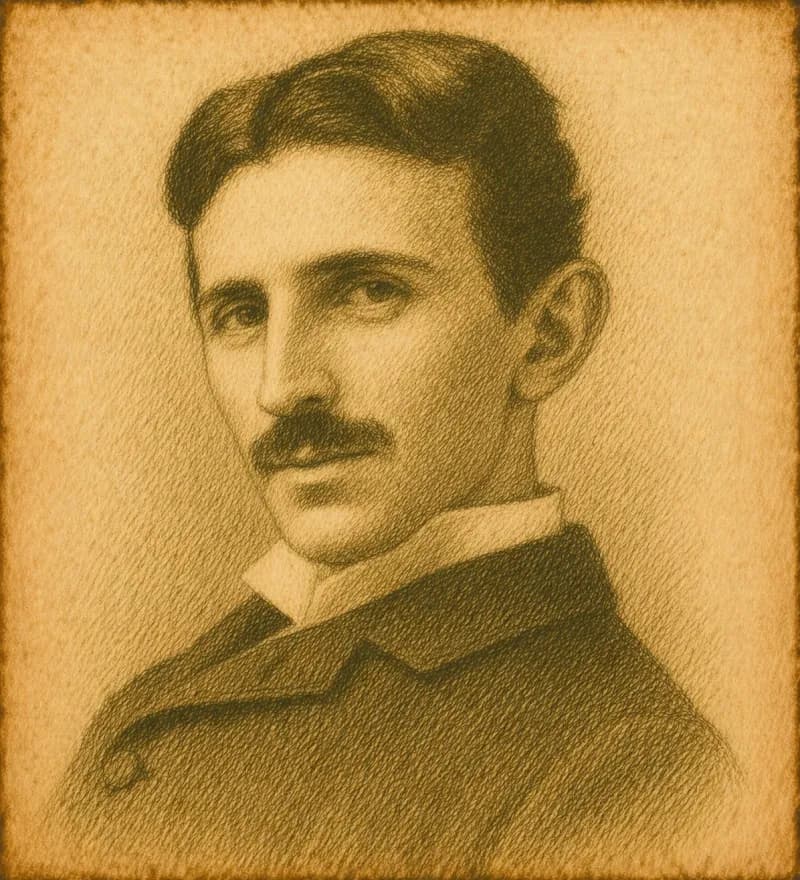
Nikola Tesla
Nikola Tesla
Inventor & Electrical Engineer
SECTION I -- SUBJECT PROFILE
| Name | Nikola Tesla |
|---|---|
| English | Nikola Tesla |
| Nationality | Austria |
| Lifespan | 1856–1943 |
| Gender | Male |
| Century | 19th C. |
| Field | Science |
| Title | Inventor & Electrical Engineer |
SECTION II -- OVERVIEW
Nikola Tesla was born in 1856 in the remote mountain village of Smiljan, then part of the Austrian Empire and now in Croatia, the fourth child of a Serbian Orthodox priest and an inventive mother who, though unschooled, built her own household appliances in her head.From childhood he showed a startling gift.
Complex images formed spontaneously in his mind in vivid detail, a condition now called eidetic imagery, and he could design machines internally and see them running before a single part was built.His idolized elder brother Dane died in a riding accident when Nikola was five, a loss that haunted him for the rest of his life.
The first turning point came during his teens.Struck down by what seems to have been cholera, he nearly died, and extracted from his heartbroken father a promise that, if he recovered, he could study engineering instead of the priesthood.
He entered the Austrian Polytechnic at Graz and studied with such obsessive intensity that professors grew alarmed.After years of itinerant work in Budapest and Paris, he arrived in New York in 1884 with four cents in his pocket and a letter of introduction to Thomas Edison.
The second turning point came when Tesla and Edison quarreled and parted ways.Convinced that the future lay with alternating current rather than Edison's direct current, Tesla teamed with the industrialist George Westinghouse.
In 1888 he patented his polyphase alternating-current induction motor, and in the bitter 'War of the Currents' that followed, AC triumphed.It lit the 1893 Chicago World's Fair and the great Niagara Falls hydroelectric station in 1895, and it remains the backbone of the world's power grid.
Tesla went on to invent the high-voltage Tesla coil, demonstrate wireless signal transmission, and dream of worldwide wireless power from his unfinished Wardenclyffe Tower.Visionary but a poor businessman, he lost control of his patents and died nearly penniless in 1943 in a New York hotel room at eighty-six.
His name now adorns cars, a magnetic unit, and the streets of the modern electrical age.
SECTION III -- CHRONOLOGY
SECTION IV -- NOTABLE STATEMENTS
“The present is theirs; the future, for which I really worked, is mine.”
“If you want to find the secrets of the universe, think in terms of energy, frequency and vibration.”
SECTION V -- FIELD NOTES
[A]Building machines in his mind
Tesla had an eidetic memory and could visualize complex machines entirely in his mind before building them, rarely needing drawings or blueprints.
SECTION VI -- LEGACY & IMPACT
Tesla's alternating current system won the 'War of Currents' against Edison's direct current and became the global standard for electrical power transmission. His inventions, including the Tesla coil and AC motor, made long-distance electricity distribution possible, powering the modern world. His visionary ideas about wireless communication, renewable energy, and robotics were decades ahead of their time.
SECTION VII -- MAJOR WORKS
- [01]AC induction motor patent (1888)
- [02]Tesla coil (1891)
- [03]Polyphase AC power system
- [04]Radio communication experiments (1893)
- [05]Colorado Springs experiments on wireless transmission (1899)