SUBJECT FILE NO. IJM-0024
CLASSIFICATION: HISTORICAL ARCHIVE
Charles Darwin
Charles Darwin
Naturalist
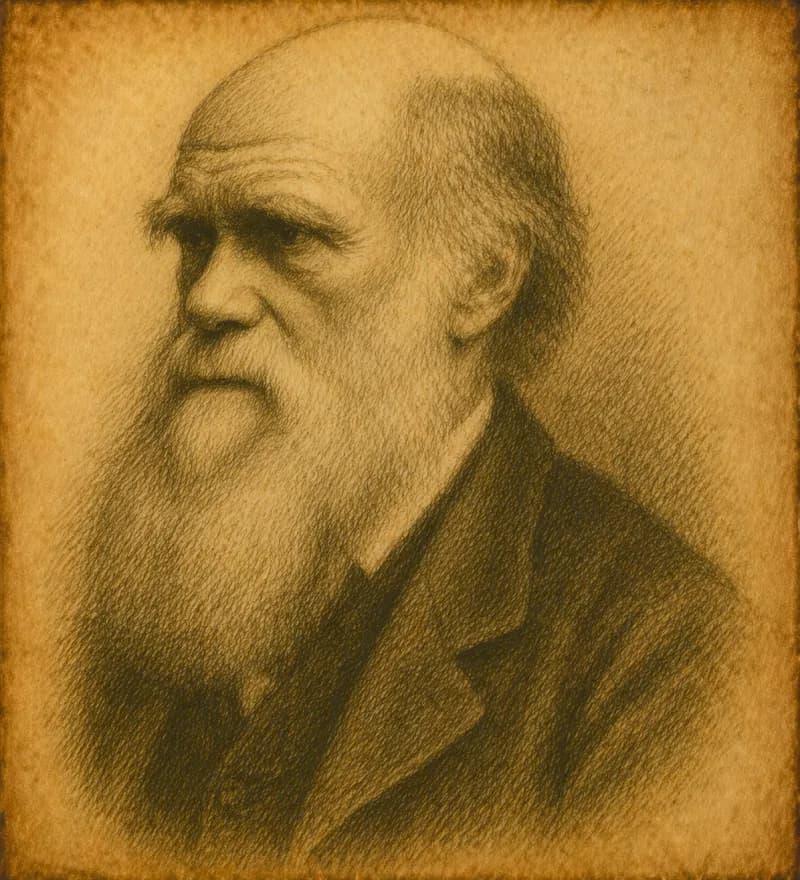
SECTION I -- SUBJECT PROFILE
| Name | Charles Darwin |
|---|---|
| English | Charles Darwin |
| Nationality | United Kingdom |
| Lifespan | 1809-1882 |
| Gender | Male |
| Century | 19th C. |
| Field | Science |
| Title | Naturalist |
SECTION II -- OVERVIEW
Charles Darwin was born in 1809 in the market town of Shrewsbury, England, the fifth of six children of the wealthy physician Robert Darwin and his wife Susannah Wedgwood, daughter of the famous potter.His grandfather Erasmus Darwin had been a prominent naturalist and poet who had already flirted with evolutionary ideas.
Charles lost his mother at eight, grew up somewhat aimlessly under the care of his elder sisters, and showed a passionate boyhood interest in collecting beetles, geology, and shooting birds, rather than in schoolbooks.The first turning point came in his early twenties.
Sent to Edinburgh to study medicine, he was horrified by the crude surgery of the pre-anesthesia era and fled the university.His disappointed father packed him off to Cambridge to prepare for the Anglican priesthood, but there he was befriended by the botany professor John Stevens Henslow, who recognized his rare powers of observation.
When a request came for an unpaid naturalist to accompany the survey ship HMS Beagle around the world, Henslow recommended the twenty-two-year-old Darwin.The voyage of the Beagle, from 1831 to 1836, was the defining experience of his life.
In South America he found fossil bones of giant extinct mammals, in the Andes marine shells at great altitude, and in the Galápagos Islands he noticed that finches and tortoises differed subtly from one island to the next.Back in England he settled at Down House in Kent and married his cousin Emma Wedgwood, cautiously building up an argument that species were not fixed but descended with modification from common ancestors, shaped by natural selection.
The second turning point came in 1858, after twenty years of delay, when a letter arrived from Alfred Russel Wallace sketching essentially the same theory.Jointly announced and then fully elaborated in On the Origin of Species in 1859, the idea sparked a storm of controversy and reshaped biology.
Dogged by illness, Darwin continued working on earthworms, orchids, and human evolution until his death in 1882 at seventy-three.He is buried in Westminster Abbey, near Isaac Newton.
SECTION III -- CHRONOLOGY
SECTION IV -- NOTABLE STATEMENTS
“It is not the strongest of the species that survives, nor the most intelligent, but the one most responsive to change.”
SECTION V -- FIELD NOTES
[A]A 20-year delay
Darwin delayed publishing his theory for 20 years, fearing the controversy it would ignite, until Alfred Russell Wallace independently developed the same theory, forcing Darwin's hand.
SECTION VI -- LEGACY & IMPACT
Darwin's theory of evolution by natural selection is the unifying principle of modern biology, explaining the diversity of life on Earth. His work fundamentally changed humanity's understanding of its place in the natural world and influenced fields far beyond biology, including psychology, anthropology, and philosophy. On the Origin of Species remains one of the most consequential books ever published.
SECTION VII -- MAJOR WORKS
- [01]On the Origin of Species (1859)
- [02]The Descent of Man (1871)
- [03]The Voyage of the Beagle (1839)
- [04]The Expression of the Emotions in Man and Animals (1872)
- [05]The Formation of Vegetable Mould through the Action of Worms (1881)