SUBJECT FILE NO. IJM-0040
CLASSIFICATION: HISTORICAL ARCHIVE
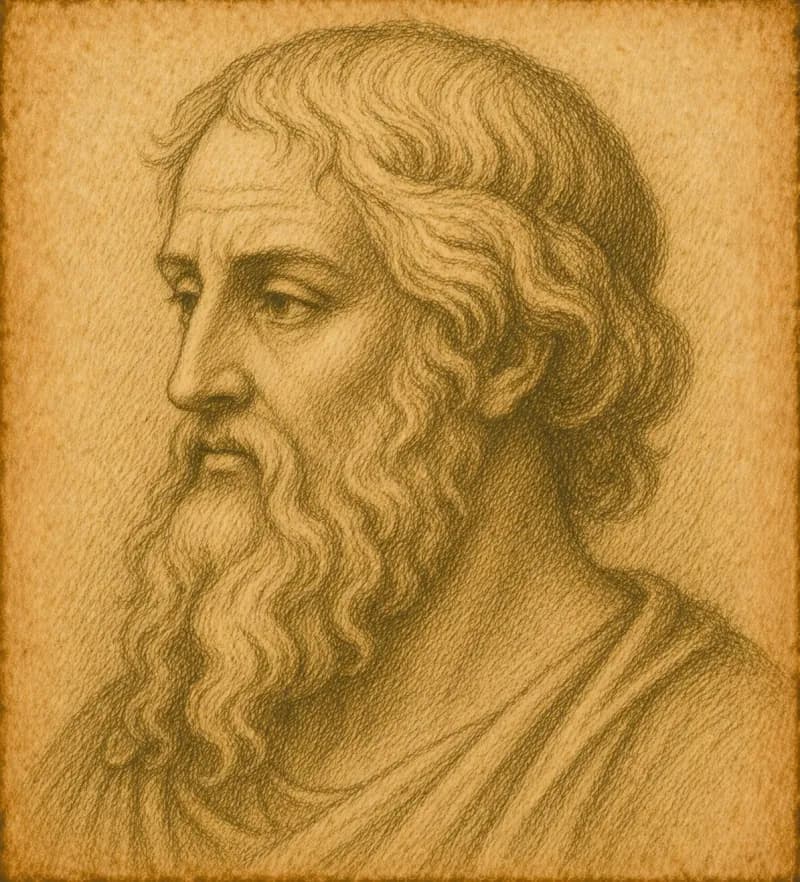
Plato
Plato
Philosopher
SECTION I -- SUBJECT PROFILE
| Name | Plato |
|---|---|
| English | Plato |
| Nationality | Greece |
| Lifespan | c.428 BC–c.348 BC |
| Gender | Male |
| Century | BC |
| Field | Philosophy |
| Title | Philosopher |
SECTION II -- OVERVIEW
Plato was born around 428 BC in Athens, into one of the city's great aristocratic families that claimed descent on one side from Solon and on the other from the last kings of Athens.His given name was Aristocles, after his grandfather, but according to later tradition his wrestling master nicknamed him Plato, meaning 'broad,' either for his powerful shoulders, his wide forehead, or the breadth of his eloquence.
Raised to expect a political career in the turbulent democracy of Athens during the Peloponnesian War, he wrote tragic plays as a young man and competed in athletic games.The first turning point came in his late teens when he encountered Socrates in the Athenian agora.
Enthralled by the old philosopher's relentless questioning, Plato reportedly burned his poetic tragedies and spent the next eight years in Socrates's company, absorbing his teacher's conviction that the unexamined life is not worth living.That idyll was shattered by the political catastrophes that ended the Peloponnesian War.
When the restored democracy in 399 BC tried and executed Socrates on charges of impiety, Plato, now around twenty-eight, was left permanently disillusioned with all existing forms of government.The second turning point came with his travels to Megara, Egypt, southern Italy, and Sicily, where he studied Pythagorean mathematics and repeatedly, and unsuccessfully, tried to turn the tyrant Dionysius of Syracuse into a philosopher-king.
Returning to Athens around 387 BC, he founded his school, the Academy, in a grove sacred to the hero Akademos just outside the city walls, a scholarly community of shared meals, lectures, and dialectical conversation that would endure for almost nine centuries.There he wrote some thirty-five dialogues, including the Apology of Socrates, Phaedo, Symposium, Phaedrus, Parmenides, Theaetetus, Timaeus, and above all the Republic, a vast inquiry into justice, the soul, and the ideal polis.
He advanced the theory of Forms, the allegory of the cave, and the tripartite soul, and he taught Aristotle for twenty years.He died at around eighty in 348 BC, and the Western philosophical tradition has been commentary on him ever since.
SECTION III -- CHRONOLOGY
SECTION IV -- NOTABLE STATEMENTS
“The measure of a man is what he does with power.”
“Be kind, for everyone you meet is fighting a hard battle.”
SECTION V -- FIELD NOTES
[A]A wrestler's nickname
「Plato」was actually a nickname meaning「broad」- possibly referring to his broad shoulders from wrestling. His real name was Aristocles.
SECTION VI -- LEGACY & IMPACT
Plato's philosophical writings established the framework for Western metaphysics, epistemology, and political theory. His Academy, the first institution of higher learning in the Western world, operated for nearly 900 years. The theory of Forms, the Allegory of the Cave, and The Republic continue to be central texts in philosophy curricula worldwide, and the phrase 'Platonic' has entered everyday language.
SECTION VII -- MAJOR WORKS
- [01]The Republic (c.380 BC)
- [02]The Symposium (c.385 BC)
- [03]Apology of Socrates (c.399 BC)
- [04]Phaedo (c.360 BC)
- [05]Founding of the Academy (c.387 BC)