SUBJECT FILE NO. IJM-0018
CLASSIFICATION: HISTORICAL ARCHIVE
Socrates
Socrates
Philosopher
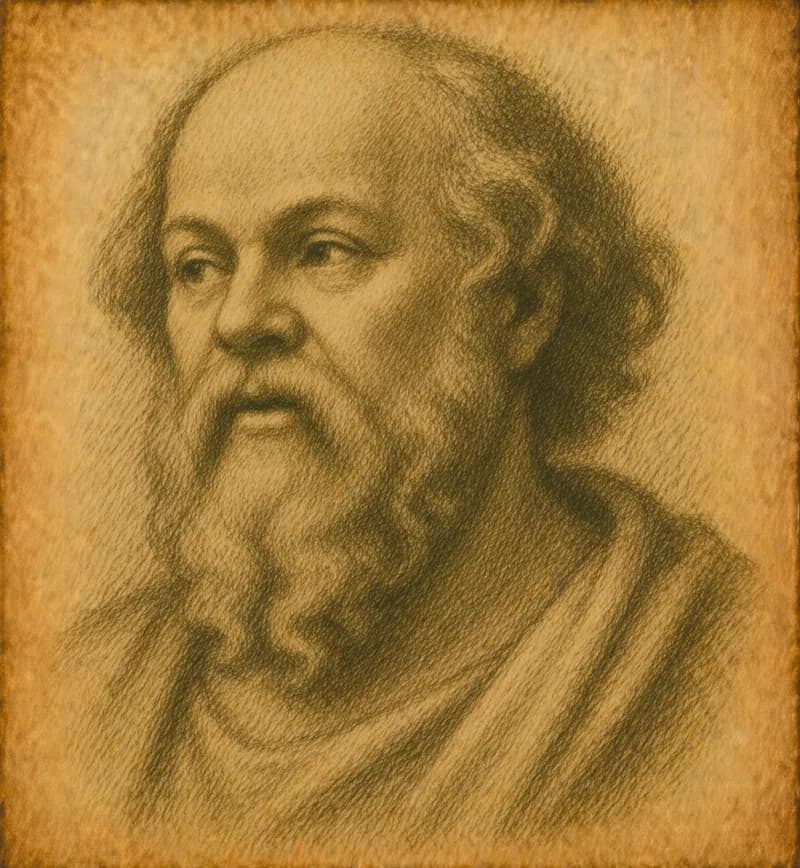
SECTION I -- SUBJECT PROFILE
| Name | Socrates |
|---|---|
| English | Socrates |
| Nationality | Greece |
| Lifespan | 470 BC – 399 BC |
| Gender | Male |
| Century | BC |
| Field | Philosophy |
| Title | Philosopher |
SECTION II -- OVERVIEW
Socrates was born around 470 BC in Athens, the son of a stonemason named Sophroniscus and a midwife named Phaenarete.He grew up in a city at the height of its golden age under Pericles, where democracy, drama, and philosophy all flourished.
Trained at first in his father's trade of stone-cutting, he later served as a hoplite in the Peloponnesian War, distinguishing himself at the sieges of Potidaea and Delium by his astonishing endurance of cold, hunger, and fatigue and his calm steadiness in retreat.By middle age he had grown strange in the eyes of his fellow citizens, a snub-nosed, bulging-eyed, barefoot figure who wandered the agora buttonholing generals and politicians for conversation.
The first turning point came, according to Plato, when his friend Chaerephon brought back word from the oracle at Delphi that no one was wiser than Socrates.Puzzled, since he believed he knew nothing, Socrates set out to refute the oracle by interrogating those reputed for wisdom.
He concluded that others were no wiser than he, but imagined themselves to be so, while he at least knew that he did not know.This discovery became his lifelong mission: to question his fellow Athenians, especially the young, about justice, piety, courage, and the good life, drawing out their unexamined assumptions by relentless questioning.
His method, which later became known as the Socratic method, attracted devoted disciples including Plato and Xenophon.The second turning point came in 399 BC in the bitter atmosphere following Athens's defeat by Sparta.
Charged with impiety and corrupting the young, Socrates defended himself before the assembly with unyielding dignity, refusing to appease his accusers.Condemned to death by a narrow majority, he waited calmly in his cell until the ship returned from Delos, declined an offer to escape into exile, and drank the hemlock among his friends.
He was seventy.Though he wrote nothing himself, his example established philosophy as a way of life and his question 'How should we live?' still defines Western thought.
SECTION III -- CHRONOLOGY
SECTION IV -- NOTABLE STATEMENTS
“The unexamined life is not worth living.”
“I know that I know nothing.”
SECTION V -- FIELD NOTES
[A]The philosopher who refused to escape
Despite being offered escape from prison by his friends, Socrates refused, arguing that breaking the law would undermine everything he had taught about justice.
SECTION VI -- LEGACY & IMPACT
Socrates established the practice of rigorous philosophical inquiry through dialogue, creating the Socratic method that remains central to Western education and legal practice. By insisting that the unexamined life is not worth living, he made self-reflection and critical thinking the cornerstones of Western intellectual tradition. His willingness to die for his principles made him the archetypal philosopher-martyr.
SECTION VII -- MAJOR WORKS
- [01]Socratic method of dialectical questioning
- [02]Defense speech at his trial (Apology, recorded by Plato)
- [03]Ethical philosophy centered on virtue and knowledge
- [04]Influence on Plato's dialogues (Phaedo, Symposium, Republic)
- [05]Concept of the examined life