SUBJECT FILE NO. IJM-0042
CLASSIFICATION: HISTORICAL ARCHIVE
Karl Marx
Karl Marx
Philosopher, Economist, Political Theorist
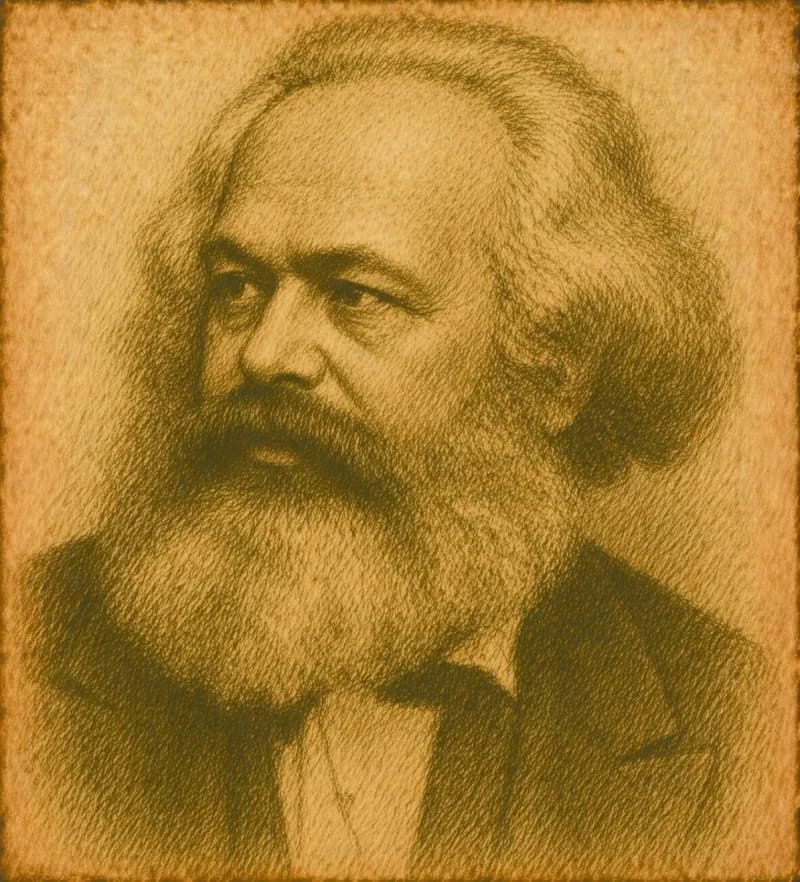
SECTION I -- SUBJECT PROFILE
| Name | Karl Marx |
|---|---|
| English | Karl Marx |
| Nationality | Germany |
| Lifespan | 1818–1883 |
| Gender | Male |
| Century | 19th C. |
| Field | Philosophy |
| Title | Philosopher, Economist, Political Theorist |
SECTION II -- OVERVIEW
Karl Marx was born in 1818 in the Rhineland city of Trier, in a prosperous middle-class family descended on both sides from long lines of rabbis.His father Heinrich, a respected lawyer, had converted from Judaism to Lutheranism to practice law under Prussian restrictions on Jewish officials, and raised his son in a home filled with the ideals of the Enlightenment and the French Revolution.
After an outstanding secondary education, Karl entered the University of Bonn and then Berlin, where he threw himself into the philosophy of G.W.F.
Hegel and joined the circle of Young Hegelians debating religion and politics in smoke-filled cafés.The first turning point came as he completed his doctorate in 1841 on ancient Greek atomism, only to find himself barred from an academic career because of his radical reputation.
Forced to earn a living by his pen, he became editor of the liberal Rheinische Zeitung in Cologne, where his attacks on censorship and feudal abuses led the Prussian government to shut the paper down.In 1843 he married his childhood friend Jenny von Westphalen, a noblewoman from Trier, and moved to Paris.
There, in the ferment of exiled German artisans, French socialists, and Polish revolutionaries, came his second and decisive turning point: his meeting in 1844 with Friedrich Engels, a young German factory owner who would become his lifelong collaborator, patron, and friend.From Engels's firsthand reports on the misery of Manchester cotton workers and Marx's philosophical training grew their shared doctrine of historical materialism.
In 1848 they published The Communist Manifesto, summoning the workers of the world to unite.Expelled from country after country, Marx settled in London in 1849 and spent the next two decades in the Reading Room of the British Museum, researching capitalism through sickness and devastating poverty that killed several of his children.
In 1867 the first volume of Das Kapital appeared, a monumental anatomy of capitalist production, the origin of profit, and the logic of class conflict.He organized the International Workingmen's Association before dying in London in 1883 at sixty-four.
SECTION III -- CHRONOLOGY
SECTION IV -- NOTABLE STATEMENTS
“The philosophers have only interpreted the world in various ways. The point, however, is to change it.”
“History repeats itself, first as tragedy, second as farce.”
SECTION V -- FIELD NOTES
[A]Writing in poverty
Marx lived in poverty in London, surviving largely on financial support from his friend Friedrich Engels while writing Das Kapital.
SECTION VI -- LEGACY & IMPACT
Marx's critique of capitalism and his theory of historical materialism became the intellectual foundation for socialist and communist movements that reshaped the political map of the 20th century. Whether embraced or rejected, his analysis of class struggle, labor exploitation, and economic inequality remains central to debates in economics, sociology, and political science today.
SECTION VII -- MAJOR WORKS
- [01]Das Kapital, Volume 1 (1867)
- [02]The Communist Manifesto (with Engels, 1848)
- [03]The Eighteenth Brumaire of Louis Bonaparte (1852)
- [04]Grundrisse (economic manuscripts, 1857-1858)
- [05]A Contribution to the Critique of Political Economy (1859)