SUBJECT FILE NO. IJM-0012
CLASSIFICATION: HISTORICAL ARCHIVE
Confucius
Confucius
Philosopher & Educator
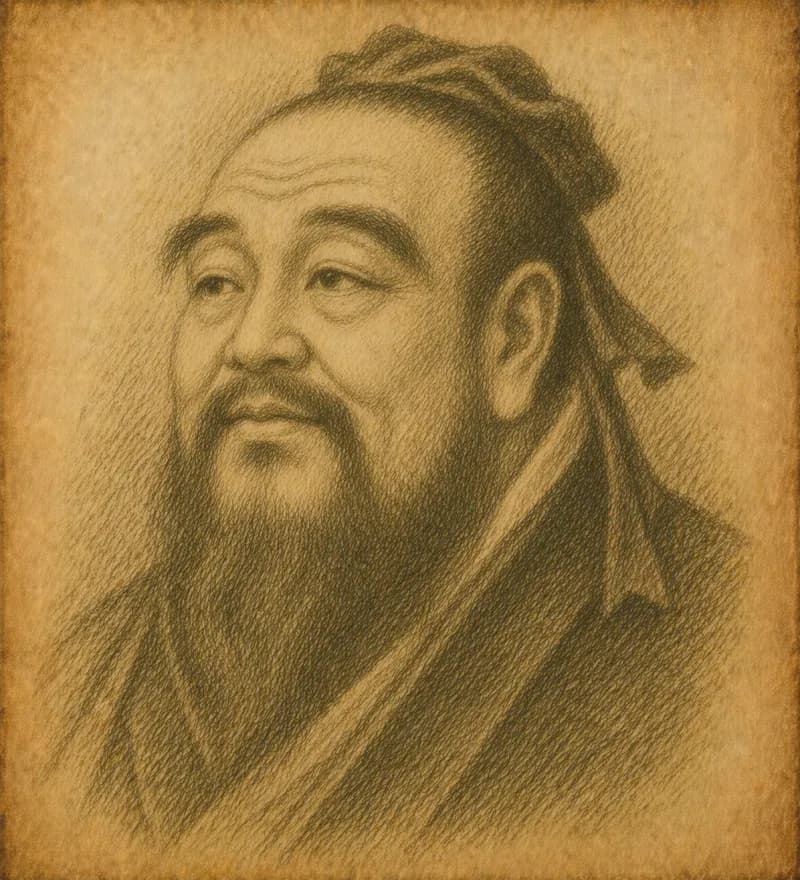
SECTION I -- SUBJECT PROFILE
| Name | Confucius |
|---|---|
| English | Confucius |
| Nationality | China |
| Lifespan | 551 BC – 479 BC |
| Gender | Male |
| Century | BC |
| Field | Philosophy |
| Title | Philosopher & Educator |
SECTION II -- OVERVIEW
Confucius, originally named Kong Qiu and styled Zhongni, was born in 551 BC in the small state of Lu in what is now Shandong province, during the turbulent Spring and Autumn period when the old Zhou dynasty order was collapsing into feuding principalities.His father, said to be a warrior of declining minor nobility, died when Confucius was only three, leaving his young mother to raise him in poverty.
As a boy he worked humble jobs, assisting at funerals and tending livestock, and through these tasks he absorbed the ancient rites and music of the Zhou.The first turning point came, by his own account, at the age of fifteen, when he 'set his heart on learning.
' Almost entirely self-taught, he immersed himself in the Classic of Poetry, the Book of Documents, and the Zhou rites, becoming an expert on ceremony and good governance.His reputation as a scholar opened modest official posts in the Lu government, and by his early fifties he had risen to become Minister of Crime.
But his reformist ambitions alienated the great noble families, and he was effectively forced from office.The second turning point came with his decision, at around fifty-five, to leave Lu and wander through the neighboring states with a band of devoted disciples for some fourteen years, searching unsuccessfully for a ruler who would put his teachings into practice.
He was mocked, threatened, and once nearly starved, but he refused to compromise.In his final years he returned home and devoted himself entirely to teaching and to editing the classics, accepting students regardless of social rank under his principle of 'education without class distinction.
' He died in 479 BC at seventy-three.The Analects, compiled by his disciples after his death, distilled his teachings on humaneness (ren), ritual propriety (li), and the cultivation of the junzi or noble person, and for 2,500 years Confucianism has been the ethical spine of Chinese, Korean, Japanese, and Vietnamese civilizations.
SECTION III -- CHRONOLOGY
SECTION IV -- NOTABLE STATEMENTS
“Do not impose on others what you yourself do not desire.”
“Learning without thought is labor lost; thought without learning is perilous.”
“To err and not to reform—this is what may truly be called an error.”
SECTION V -- FIELD NOTES
[A]Three thousand disciples
Some 3,000 students are said to have studied under Confucius, of whom the most outstanding are known as the 'Ten Philosophers.' His principle of teaching without regard to class or origin is sometimes called the world's first private-school ethos.
SECTION VI -- LEGACY & IMPACT
Confucius shaped the moral and political philosophy of East Asia for over 2,500 years. His teachings on filial piety, social harmony, and virtuous governance became the bedrock of Chinese, Korean, Japanese, and Vietnamese civilizations. Confucianism influenced everything from government administration to family structure, and his emphasis on education as a path to self-improvement remains a driving cultural force today.
SECTION VII -- MAJOR WORKS
- [01]The Analects (compiled by disciples)
- [02]Editing of the Five Classics (Spring and Autumn Annals, Book of Odes, Book of Rites, Book of Changes, Book of Documents)
- [03]Establishment of private education tradition
- [04]Doctrine of the Mean (attributed)