SUBJECT FILE NO. IJM-0014
CLASSIFICATION: HISTORICAL ARCHIVE
Mahatma Gandhi
Mahatma Gandhi
Independence Leader & Civil Rights Activist
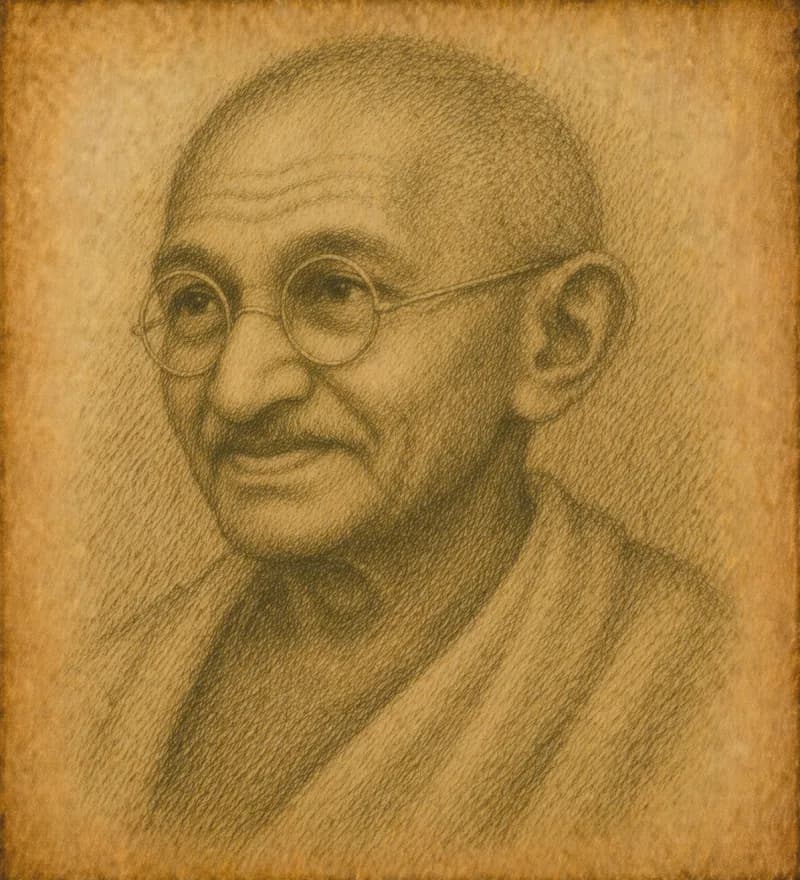
SECTION I -- SUBJECT PROFILE
| Name | Mahatma Gandhi |
|---|---|
| English | Mahatma Gandhi |
| Nationality | India |
| Lifespan | 1869–1948 |
| Gender | Male |
| Century | 20th C. |
| Field | Politics |
| Title | Independence Leader & Civil Rights Activist |
SECTION II -- OVERVIEW
Mohandas Karamchand Gandhi, later honored as Mahatma, or 'Great Soul,' was born in 1869 in the small coastal town of Porbandar in western India, where his father served as the dewan, or prime minister, of a minor princely state.His mother Putlibai was deeply devout, fasting frequently and instilling in her youngest son the Jain and Vaishnava principles of vegetarianism and ahimsa, or non-harm.
A shy, unremarkable student, he was married at thirteen in an arranged child marriage to Kasturba, and at nineteen he traveled to London to study law, pledging to his mother that he would abstain from meat, alcohol, and women.The first turning point came in 1893, shortly after he arrived in South Africa to represent an Indian merchant.
Holding a first-class ticket, he was thrown off a train at Pietermaritzburg station because he was a person of color.Shivering on the platform through the night, the young lawyer decided he would not return home until he had confronted this injustice.
For the next twenty-one years he organized the Indian community in South Africa, developing his philosophy of satyagraha, or truth-force, a disciplined method of nonviolent civil disobedience.The second turning point came with his return to India in 1915.
Dressed in a simple hand-woven dhoti and armed only with moral authority, he transformed the Indian National Congress from an elite debating society into a mass movement.The Salt March of 1930, a 240-mile walk to the sea to defy the British salt monopoly, galvanized the world.
He was imprisoned repeatedly, fasted publicly to halt communal violence, and spun thread on a charkha as a symbol of economic self-reliance.After decades of struggle, India gained independence in August 1947, though the accompanying partition into India and Pakistan unleashed appalling communal massacres that devastated him.
On January 30, 1948, as he walked to evening prayer in Delhi, he was shot dead by a Hindu extremist.His personal effects were worth less than two dollars.His philosophy of nonviolent resistance inspired Martin Luther King Jr.
, Nelson Mandela, and countless others.
SECTION III -- CHRONOLOGY
SECTION IV -- NOTABLE STATEMENTS
“Be the change you wish to see in the world.”
“An eye for an eye only ends up making the whole world blind.”
SECTION V -- FIELD NOTES
[A]Possessions worth less than $2
His personal possessions at death were worth less than $2. He owned only a few items including his glasses, sandals, and a pocket watch.
SECTION VI -- LEGACY & IMPACT
Gandhi's philosophy of nonviolent resistance inspired civil rights and freedom movements across the world, from Martin Luther King Jr. in America to Nelson Mandela in South Africa. His methods proved that an empire could be challenged without violence, fundamentally changing the tactics of political protest. India's independence in 1947 demonstrated the power of mass nonviolent action.
SECTION VII -- MAJOR WORKS
- [01]Salt March / Dandi March (1930)
- [02]Quit India Movement (1942)
- [03]Indian Opinion newspaper (founded 1903)
- [04]The Story of My Experiments with Truth (autobiography, 1927)
- [05]Promotion of Khadi and Swadeshi movements