SUBJECT FILE NO. IJM-0006
CLASSIFICATION: HISTORICAL ARCHIVE
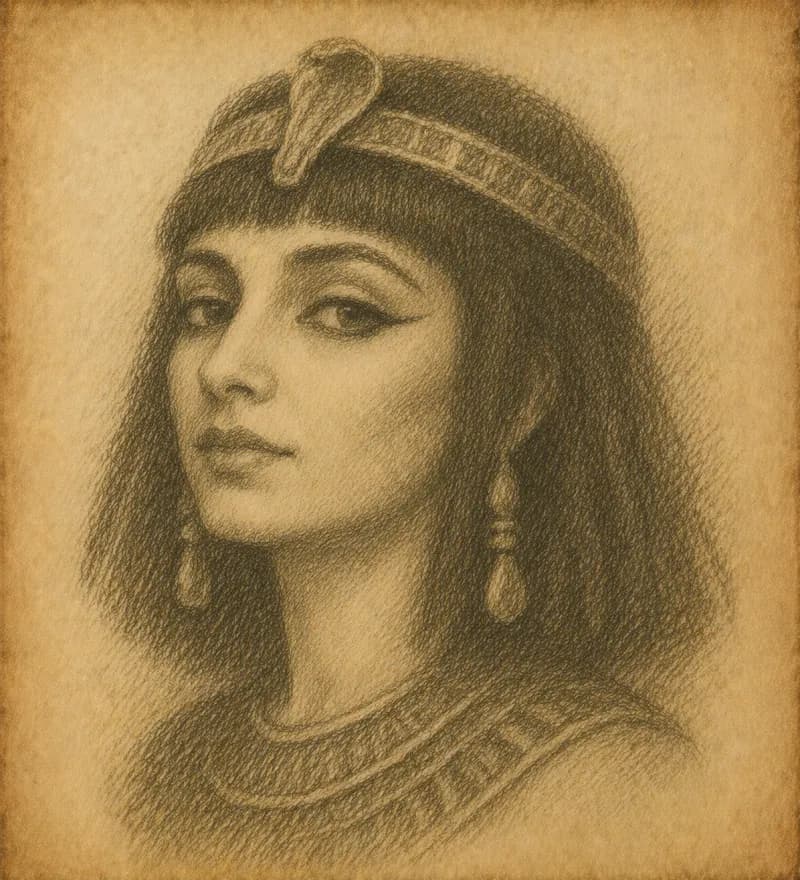
Cleopatra VII
Cleopatra VII
Queen of Ptolemaic Egypt
SECTION I -- SUBJECT PROFILE
| Name | Cleopatra VII |
|---|---|
| English | Cleopatra VII |
| Nationality | Egypt |
| Lifespan | 69 BC – 30 BC |
| Gender | Female |
| Century | BC |
| Field | Politics |
| Title | Queen of Ptolemaic Egypt |
SECTION II -- OVERVIEW
Cleopatra VII was born in 69 BC in the great Mediterranean metropolis of Alexandria, heir to the Greek-speaking Ptolemaic dynasty that had ruled Egypt for nearly three centuries.Her childhood unfolded among the scholars, astronomers, and poets of the famed Library of Alexandria, and unlike her ancestors, who had refused to learn the tongue of their subjects, she was reportedly fluent in nine languages including Egyptian.
She embraced the roles of Isis and pharaoh with studied devotion, endearing her to the native population.The first turning point came at eighteen, when the death of her father thrust her onto the throne as joint ruler with her younger brother Ptolemy XIII.
Court intrigues soon drove her into exile, and in 48 BC she gambled everything by having herself smuggled into the palace, according to legend rolled inside a bedroll, to appear before Julius Caesar.The Roman dictator, charmed by her intelligence and audacity, restored her to power.
Their liaison produced a son, Caesarion, and for a time her political survival seemed secured by Rome itself.The second turning point came with Caesar's assassination in 44 BC.Navigating the chaos of Roman civil war, Cleopatra formed an alliance with Mark Antony, summoning him to Tarsus aboard a gilded barge in one of history's most theatrical diplomatic gestures.
The two became lovers and allies, and with Antony she pursued a grand vision of an eastern empire blending Greek, Egyptian, and Roman worlds.But Octavian, Caesar's heir, declared war and crushed their combined fleet at the Battle of Actium in 31 BC.
The following year, as Roman legions entered Alexandria, Cleopatra chose death on her own terms, reportedly by the bite of an asp, dying at thirty-nine.Her end marked the close of the Hellenistic age and the beginning of Roman Egypt.
For more than two thousand years, the last queen of the Ptolemies has inspired poets, playwrights, and filmmakers, her intelligence and will still luminous across the centuries.
SECTION III -- CHRONOLOGY
SECTION IV -- NOTABLE STATEMENTS
“I will live as a queen and die as a queen.”
SECTION V -- FIELD NOTES
[A]Not actually a legendary beauty?
Coin portraits suggest Cleopatra was not the 'great beauty' of legend. The ancient historian Plutarch wrote that her charm lay 'not in her appearance alone, but in her conversation and intellect.' She spoke nine languages and was well-versed in diplomacy and scholarship.
SECTION VI -- LEGACY & IMPACT
Cleopatra was the last active ruler of the Ptolemaic Kingdom, and her death marked the end of Hellenistic Egypt and its absorption into the Roman Empire. Her political acumen and cultural patronage preserved Egyptian independence for two decades against Roman expansion, and her legend has inspired countless works of art, literature, and film for over two millennia.
SECTION VII -- MAJOR WORKS
- [01]Alliance with Julius Caesar (48 BC)
- [02]Alliance with Mark Antony (41 BC)
- [03]Construction of the Caesareum temple in Alexandria
- [04]Expansion of Egyptian naval fleet
- [05]Restoration of Ptolemaic territorial claims