SUBJECT FILE NO. IJM-0022
CLASSIFICATION: HISTORICAL ARCHIVE
Pablo Picasso
Pablo Picasso
Painter & Sculptor
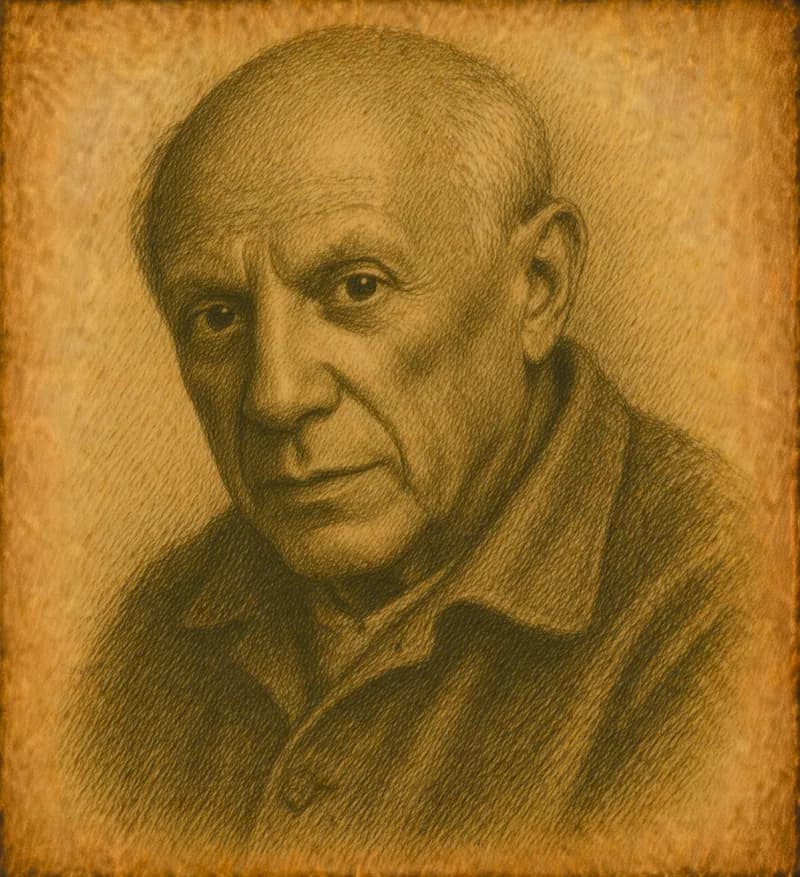
SECTION I -- SUBJECT PROFILE
| Name | Pablo Picasso |
|---|---|
| English | Pablo Picasso |
| Nationality | Spain |
| Lifespan | 1881–1973 |
| Gender | Male |
| Century | 20th C. |
| Field | Art |
| Title | Painter & Sculptor |
SECTION II -- OVERVIEW
Pablo Picasso was born in 1881 in the sun-drenched Mediterranean port of Málaga in southern Spain, the son of José Ruiz y Blasco, a painter and drawing teacher, and María Picasso y López.According to family legend, his first word was 'piz, piz,' his way of asking for a pencil.
He could draw before he could speak.His father, recognizing genius at a glance, gave his thirteen-year-old son his own brushes and palette and is said to have renounced painting forever.
The first turning point came when the family moved to Barcelona and Pablo entered the city's School of Fine Arts, completing in a day an entrance exam meant to take a month.By sixteen he had already mastered academic technique, and in the bohemian cafés of Barcelona he met the writers and artists who would push him toward modernism.
In 1900 he traveled to Paris and plunged into the life of Montmartre.The suicide of his closest friend Carles Casagemas plunged him into the melancholy 'Blue Period,' followed by a gentler 'Rose Period' of harlequins and acrobats.
The second, decisive turning point came in 1907 with Les Demoiselles d'Avignon, a brutal, fractured composition of five women influenced by Iberian sculpture and African masks.Working closely with Georges Braque, he developed Cubism, which shattered five centuries of Western perspective and allowed a single object to be viewed from multiple angles at once.
From that revolution his restless innovation never stopped.He moved through a Neoclassical period, collaborated with Surrealists, and designed sets for the Ballets Russes.In 1937, shocked by the Nazi bombing of the Basque town of Guernica during the Spanish Civil War, he painted Guernica, an enormous black-and-white canvas that remains the most powerful anti-war image of the twentieth century.
He continued to paint, sculpt, engrave, and make pottery into his nineties, producing around fifty thousand works in all.He died in 1973 at the age of ninety-one at his home in Mougins, having redrawn the map of twentieth-century art as no other artist has done.
SECTION III -- CHRONOLOGY
SECTION IV -- NOTABLE STATEMENTS
“Every child is an artist. The problem is how to remain an artist once he grows up.”
“Art washes away from the soul the dust of everyday life.”
SECTION V -- FIELD NOTES
[A]A 23-word full name
His full name contains 23 words: Pablo Diego Jose Francisco de Paula Juan Nepomuceno Maria de los Remedios Cipriano de la Santisima Trinidad Ruiz y Picasso.
SECTION VI -- LEGACY & IMPACT
Picasso co-founded Cubism, the most revolutionary art movement of the 20th century, which shattered traditional perspective and reshaped how we perceive visual reality. His prolific output of approximately 50,000 works across painting, sculpture, ceramics, and printmaking demonstrated that art could be endlessly reinvented. Guernica remains the most powerful anti-war painting ever created.
SECTION VII -- MAJOR WORKS
- [01]Les Demoiselles d'Avignon (1907)
- [02]Guernica (1937)
- [03]The Old Guitarist (1903-1904)
- [04]The Weeping Woman (1937)
- [05]Dove of Peace lithograph (1949)