SUBJECT FILE NO. IJM-0011
CLASSIFICATION: HISTORICAL ARCHIVE
Anne Frank
Anne Frank
Diarist
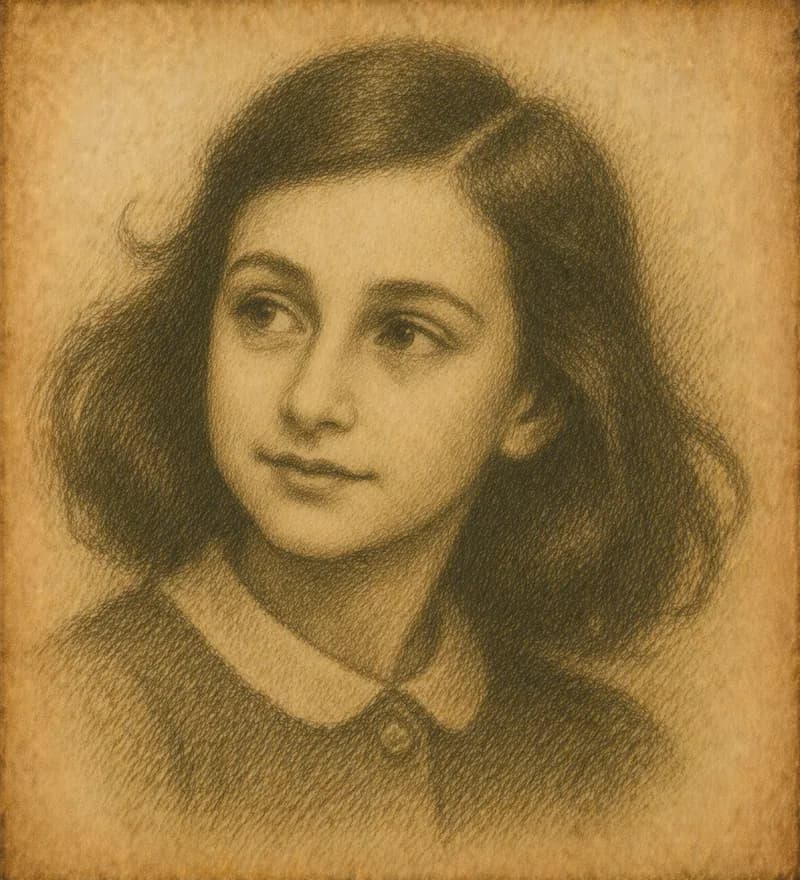
SECTION I -- SUBJECT PROFILE
| Name | Anne Frank |
|---|---|
| English | Anne Frank |
| Nationality | Germany |
| Lifespan | 1929–1945 |
| Gender | Female |
| Century | 20th C. |
| Field | Literature |
| Title | Diarist |
SECTION II -- OVERVIEW
Anne Frank was born in 1929 in Frankfurt am Main to a prosperous Jewish family, the second daughter of Otto Frank, a businessman and veteran of the German army, and Edith Frank-Holländer, a quiet and devout woman.Anne was a bright, sociable, and sometimes mischievous child who loved her older sister Margot, collected postcards of film stars, and chattered so incessantly at school that her teacher nicknamed her 'Miss Quack Quack.
' The first turning point came when she was only four.In 1933, after Hitler's rise to power and the Nazi boycott of Jewish businesses, the family fled Germany and settled in Amsterdam, where Otto rebuilt his life as the director of a pectin and spice company.
For several happy years Anne attended a Montessori school, made close friends, and absorbed Dutch as her second language.That ordinary childhood ended in 1940 when Nazi Germany invaded the Netherlands, and anti-Jewish measures began to close in.
On her thirteenth birthday, June 12, 1942, Anne received a red-checked autograph book from her father and began writing in it as though confiding in an imaginary friend she called Kitty.The second, devastating turning point came just weeks later.
When Margot received a call-up notice for forced labor, the Franks went into hiding in a concealed set of rooms above Otto's warehouse at 263 Prinsengracht, joined by four others in what Anne called 'the Secret Annex.' For over two years she recorded the fears, boredom, adolescent crushes, quarrels, and unshakable hope of eight people living in silence.
On August 4, 1944, the annex was betrayed.The occupants were deported, and Anne died of typhus at Bergen-Belsen in early 1945, weeks before liberation, at the age of fifteen.Her father, the only survivor, published her diary in 1947.
Translated into more than seventy languages, it has given the Holocaust a single unforgettable human voice and remains one of the most powerful testaments ever written against hatred.
SECTION III -- CHRONOLOGY
SECTION IV -- NOTABLE STATEMENTS
“I still believe, in spite of everything, that people are truly good at heart.”
“Everyone has inside of him a piece of good news. The good news is that you don't know how great you can be.”
SECTION V -- FIELD NOTES
[A]The diary was a birthday gift
Anne began writing on June 12, 1942—the day she received a red-checked diary as a 13th birthday gift from her father. She named the diary 'Kitty' and wrote as if confiding in an imaginary friend.
SECTION VI -- LEGACY & IMPACT
Anne Frank's diary gave the Holocaust a human face, transforming abstract statistics of genocide into the intimate, relatable voice of a teenage girl. Translated into over 70 languages and read by tens of millions, it remains one of the most powerful testimonies against hatred and intolerance, and the Anne Frank House in Amsterdam is one of the most visited museums in Europe.
SECTION VII -- MAJOR WORKS
- [01]The Diary of a Young Girl (published 1947)
- [02]Tales from the Secret Annex (short stories and essays)
- [03]The Critical Edition of the diary (1986)
- [04]The Revised Critical Edition (2003)