SUBJECT FILE NO. IJM-0004
CLASSIFICATION: HISTORICAL ARCHIVE
Natsume Soseki
Natsume Soseki
Novelist & English Literature Scholar
SECTION I -- SUBJECT PROFILE
| Name | Natsume Soseki |
|---|---|
| English | Natsume Soseki |
| Nationality | Japan |
| Lifespan | 1867–1916 |
| Gender | Male |
| Century | 19th C. |
| Field | Literature |
| Title | Novelist & English Literature Scholar |
SECTION II -- OVERVIEW
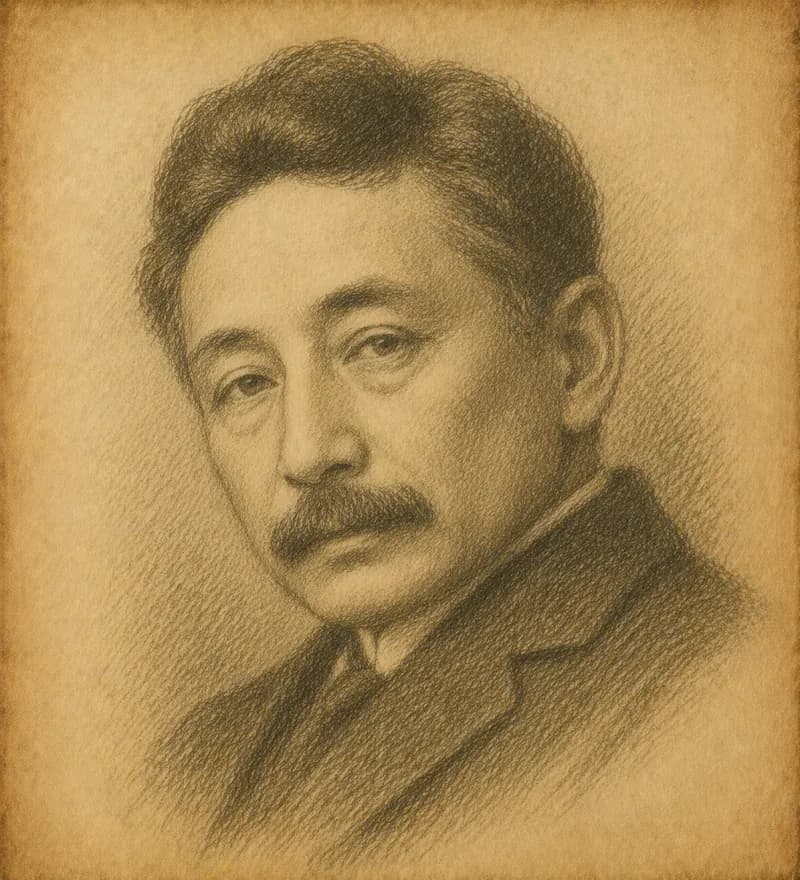
Natsume Soseki was born Natsume Kinnosuke in 1867 in the Ushigome district of Edo, just one year before the Meiji Restoration transformed Japan.The youngest of many children in a declining samurai family, he was passed from one foster home to another as an unwanted child, and the loneliness of this early life would shape the sense of isolation that runs through all his writing.
After graduating from the prestigious English Literature department of Tokyo Imperial University, he taught English at Matsuyama Middle School and the Fifth Higher School in Kumamoto, establishing himself as a steady if unremarkable scholar.The first turning point came in 1900, when the Ministry of Education sent him to London to study English literature.
Alone in a cold boarding house, overwhelmed by the crushing weight of Western culture, he suffered a nervous breakdown, but also arrived at his own philosophical principle of 'self-centered individualism,' a determination to judge the world on his own terms.When he returned to Japan in 1903, a friend suggested he write a humorous sketch for the haiku magazine Hototogisu.
That piece, narrated by a supercilious feline, grew into the celebrated novel I Am a Cat and made him, at nearly forty, a literary sensation.His second turning point came in 1907, when he made the astonishing decision to abandon his secure university professorship and join the Asahi Shimbun newspaper as a full-time novelist.
Over the next decade he produced a remarkable sequence of masterpieces: Botchan, Kusamakura, Sanshirō, And Then, The Gate, and the tragic, luminous Kokoro.His work probed the loneliness, guilt, and moral uncertainty of Japanese intellectuals caught between tradition and modernity.
Plagued by stomach ulcers, he left his final novel Light and Dark unfinished when he died in 1916 at the age of forty-nine.His face once appeared on the 1,000-yen note, and his novels remain foundational reading for every student of modern Japanese literature.
SECTION III -- CHRONOLOGY
SECTION IV -- NOTABLE STATEMENTS
“If you work by reason, you grow rough edges. If you drift on emotion, you are swept away.”
SECTION V -- FIELD NOTES
[A]The face on the 1,000-yen note
Soseki's portrait appeared on Japan's 1,000-yen banknote from 1984 to 2004. Ironically, Soseki himself reportedly disliked having his photograph circulated in public.
SECTION VI -- LEGACY & IMPACT
Soseki established the modern Japanese novel as a serious literary form, blending Western narrative techniques with Japanese sensibility. His exploration of individualism, loneliness, and the tension between tradition and modernity defined the themes of 20th-century Japanese literature and continues to resonate with readers today.
SECTION VII -- MAJOR WORKS
- [01]I Am a Cat (1905-1906)
- [02]Botchan (1906)
- [03]Kokoro (1914)
- [04]The Gate (1910)
- [05]And Then (1909)