SUBJECT FILE NO. IJM-0015
CLASSIFICATION: HISTORICAL ARCHIVE
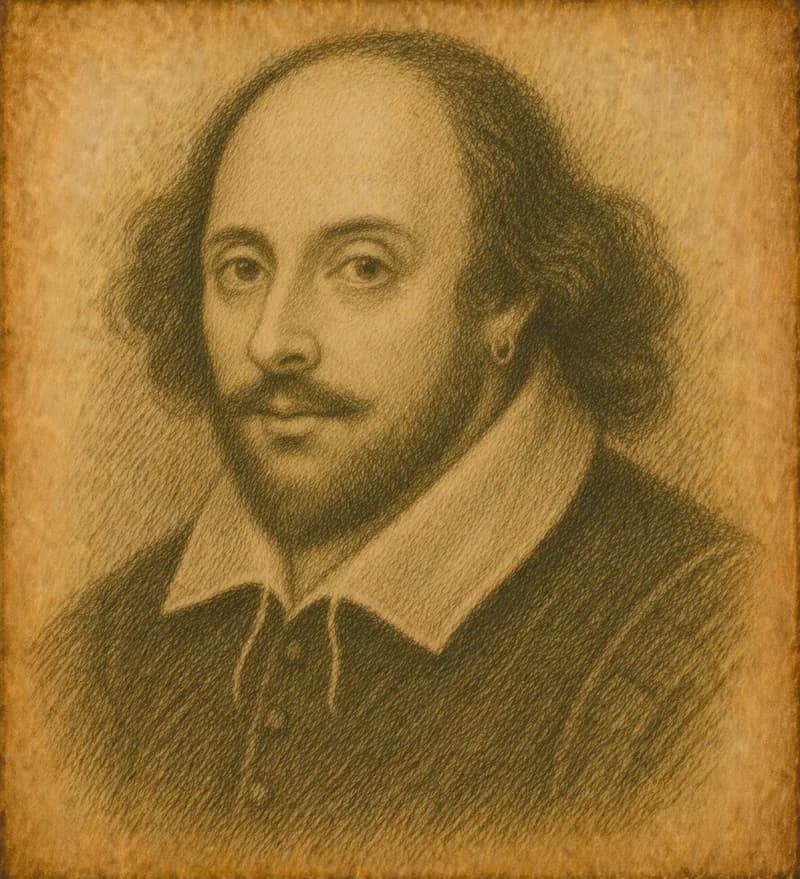
William Shakespeare
William Shakespeare
Playwright & Poet
SECTION I -- SUBJECT PROFILE
| Name | William Shakespeare |
|---|---|
| English | William Shakespeare |
| Nationality | United Kingdom |
| Lifespan | 1564–1616 |
| Gender | Male |
| Century | 16th–18th C. |
| Field | Literature |
| Title | Playwright & Poet |
SECTION II -- OVERVIEW
William Shakespeare was born in 1564 in the prosperous market town of Stratford-upon-Avon in Warwickshire, England, the eldest son of John Shakespeare, a glove-maker and local alderman, and Mary Arden, the daughter of a landowning farmer.As a boy he likely attended the town's grammar school, where he would have pored over Ovid and Virgil in Latin and mastered the rhythms of classical rhetoric.
He did not attend a university, a fact that later critics used against him, but the imaginative power he showed as a writer suggests a mind formed by voracious reading and attentive listening.At eighteen he married Anne Hathaway, a local woman eight years his senior, with whom he had three children.
Then come the so-called 'lost years,' a stretch from the mid-1580s when the trail falls silent.The first turning point came when he emerged in London in the early 1590s as a jobbing actor and rising playwright in the city's theater world.
By 1592 he had made enough of a name for the jealous dramatist Robert Greene to dismiss him sneeringly as 'an upstart Crow.' Early comedies, history plays, and Romeo and Juliet swiftly made him a favorite of the London stage.
The second turning point came with the founding of the Globe Theatre in 1599 and the accession of King James I in 1603, when Shakespeare's company came under royal patronage as the King's Men.Now financially secure, he entered an astonishing mature period in which he wrote the great tragedies Hamlet, Othello, King Lear, and Macbeth, probing the depths of ambition, jealousy, madness, and grief.
His final romances, including The Winter's Tale and The Tempest, turned toward reconciliation and wonder.Around 1611 he retired to a grand house in Stratford and died there in 1616 at the age of fifty-two.
He left behind thirty-seven plays, 154 sonnets, and roughly 1,700 words newly coined for English.Four centuries later his work is performed on every continent, and his phrases have been woven inseparably into the fabric of the language.
SECTION III -- CHRONOLOGY
SECTION IV -- NOTABLE STATEMENTS
“To be, or not to be, that is the question.”
“All the world's a stage, and all the men and women merely players.”
SECTION V -- FIELD NOTES
[A]Inventor of everyday words
Shakespeare invented words like 'lonely', 'generous', 'assassination', and 'eyeball' that are still used daily. He enriched the English language itself in a way few others ever have.
SECTION VI -- LEGACY & IMPACT
Shakespeare's plays and sonnets defined the possibilities of the English language and established the dramatic archetypes that underpin Western storytelling. He invented approximately 1,700 words still in use today and created characters of such psychological depth that they remain relevant across cultures and centuries. No other writer has had a comparable impact on world literature.
SECTION VII -- MAJOR WORKS
- [01]Hamlet (c.1600)
- [02]Romeo and Juliet (c.1595)
- [03]Macbeth (c.1606)
- [04]A Midsummer Night's Dream (c.1595)
- [05]Sonnets (154 poems, published 1609)