SUBJECT FILE NO. IJM-0031
CLASSIFICATION: HISTORICAL ARCHIVE
Tutankhamun
Tutankhamun
Pharaoh of Egypt
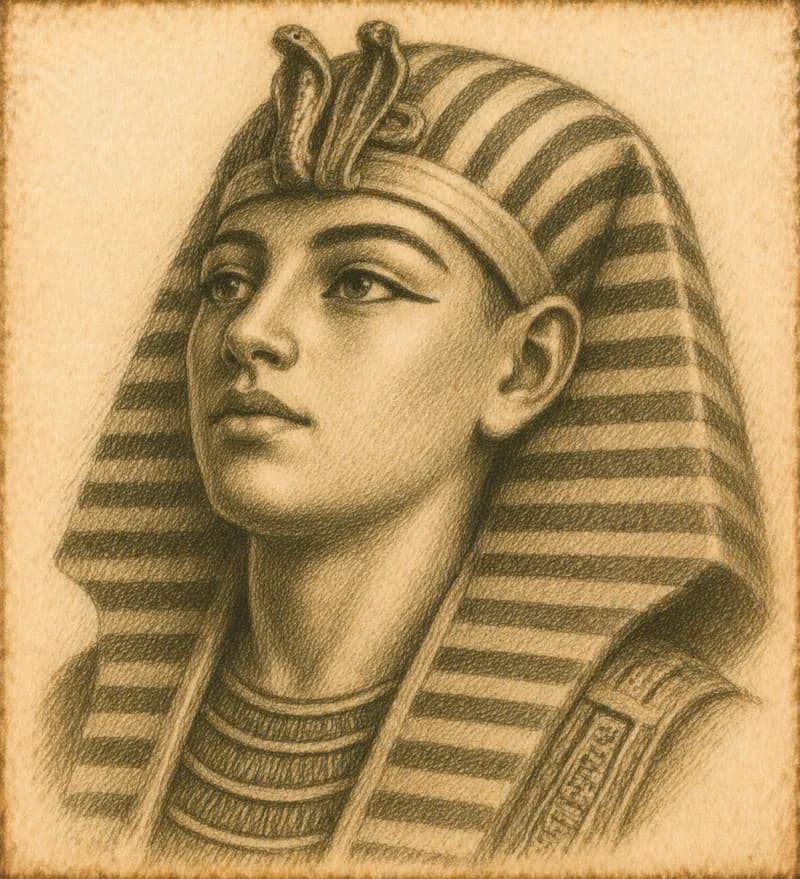
SECTION I -- SUBJECT PROFILE
| Name | Tutankhamun |
|---|---|
| English | Tutankhamun |
| Nationality | Egypt |
| Lifespan | c.1341 BC-c.1323 BC |
| Gender | Male |
| Century | BC |
| Field | Politics |
| Title | Pharaoh of Egypt |
SECTION II -- OVERVIEW
Tutankhamun was born around 1341 BC, most likely at the sprawling new capital of Akhetaten, modern Amarna, in a court convulsed by religious revolution.His father, now widely believed to have been the pharaoh Akhenaten, had overturned Egypt's ancient polytheism, closed the temples of Amun and the other great gods, and imposed the worship of a single sun disk called the Aten.
The boy was named Tutankhaten, 'living image of the Aten,' and grew up amid the strange, elongated art and empty shrines of a kingdom whose priesthood and people seethed with resentment.The first turning point came with his father's death around 1332 BC, when Tutankhamun, only about nine years old, ascended the throne in the midst of political chaos.
Under the guidance of senior officials, especially the vizier Ay and the general Horemheb, the boy king was made the symbol of a great reversal.His name was changed to Tutankhamun, 'living image of Amun,' the capital returned to Thebes, and the old temples were hastily restored.
His short reign brought tentative stability to a traumatized country.The second turning point came with his sudden death, probably around 1323 BC at the age of eighteen or nineteen.
DNA and CT studies have suggested that he suffered from malaria, a bone disorder, and a broken leg, any of which may have been fatal.Buried hastily in an unusually small tomb in the Valley of the Kings, his name was later erased from king lists and he was forgotten for more than three thousand years.
Then, in November 1922, after years of fruitless digging, the British archaeologist Howard Carter discovered the sealed entrance to tomb KV62.Peering through a breach in the door by candlelight, he described 'wonderful things.
' The tomb contained more than five thousand artifacts, including the breathtaking solid gold funerary mask weighing eleven kilograms.The discovery ignited a worldwide craze for ancient Egypt.
Today the boy king remains the most famous pharaoh of them all, his face instantly recognizable around the globe.
SECTION III -- CHRONOLOGY
SECTION IV -- NOTABLE STATEMENTS
“Death shall come on swift wings to him who disturbs the peace of the King.”
SECTION V -- FIELD NOTES
[A]Over 5,000 artifacts
His tomb contained over 5,000 artifacts, including the iconic golden death mask weighing 11 kg of solid gold.
SECTION VI -- LEGACY & IMPACT
The 1922 discovery of Tutankhamun's nearly intact tomb sparked a worldwide fascination with ancient Egypt that persists to this day. The over 5,000 artifacts recovered, especially the iconic golden death mask, transformed our understanding of Egyptian burial practices and craftsmanship. 'King Tut' became the most famous pharaoh in popular culture and his exhibitions continue to draw millions of visitors globally.
SECTION VII -- MAJOR WORKS
- [01]Golden death mask (11 kg of solid gold)
- [02]Innermost coffin of solid gold (110 kg)
- [03]Over 5,000 tomb artifacts discovered in 1922
- [04]Restoration of Amun worship after the Amarna period
- [05]Tomb KV62 in the Valley of the Kings