SUBJECT FILE NO. IJM-0020
CLASSIFICATION: HISTORICAL ARCHIVE
Catherine the Great
Catherine the Great
Empress of Russia
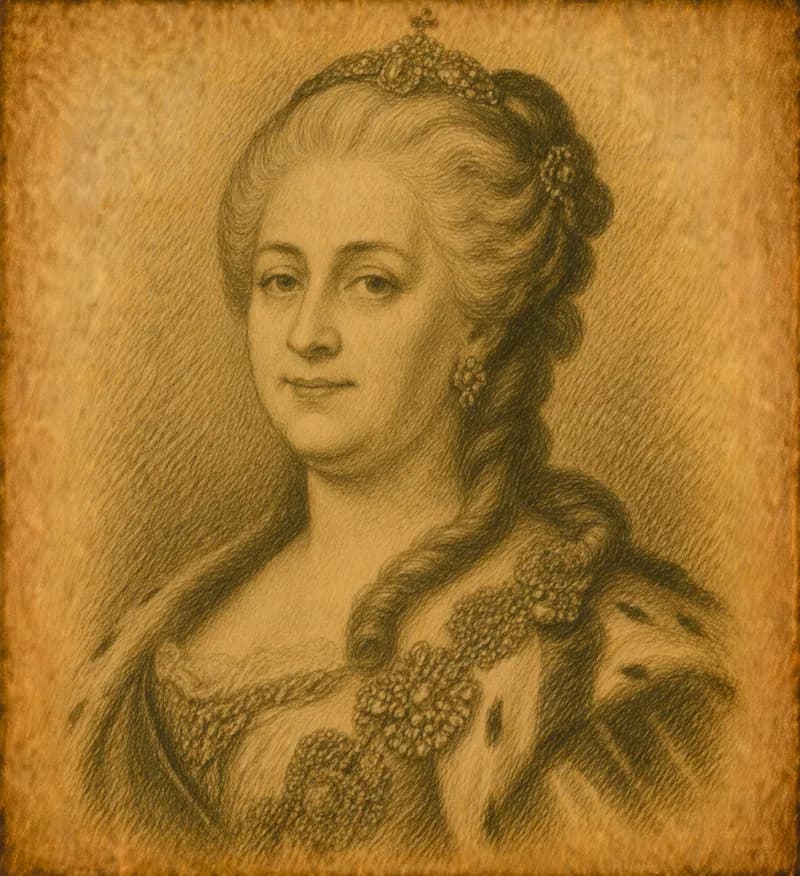
SECTION I -- SUBJECT PROFILE
| Name | Catherine the Great |
|---|---|
| English | Catherine the Great |
| Nationality | Russia |
| Lifespan | 1729–1796 |
| Gender | Female |
| Century | 16th–18th C. |
| Field | Politics |
| Title | Empress of Russia |
SECTION II -- OVERVIEW
Catherine the Great was born Sophie Friederike Auguste von Anhalt-Zerbst in 1729 in the small German duchy of Anhalt-Zerbst, the daughter of a minor Prussian prince in the service of Frederick the Great.Her childhood was modest, her mother cold and indifferent, and her education patchy, but Sophie turned her solitude into a habit of voracious reading in French, history, and philosophy.
The first turning point came at fourteen, when the Russian Empress Elizabeth, searching for a bride for her chosen heir, summoned Sophie to St.Petersburg.Arriving in 1744, the sharp-minded girl immediately set about winning over her new country: she stayed up through the night learning Russian, converted to Orthodoxy, and took the name Catherine.
Her husband, the Grand Duke Peter, proved childish, cruel, and disastrously pro-Prussian.For nearly two decades she endured a loveless marriage in which she was humiliated and watched constantly, but she used those years to deepen her political instincts, correspond with Voltaire and Diderot, and cultivate the guard regiments and the Orthodox Church.
The second turning point came in 1762, when her husband, now the deeply unpopular Peter III, was overthrown in a bloodless coup led by Catherine and her supporters in the Imperial Guard.Peter was soon murdered, and Catherine, the German princess of no imperial blood, seized the throne in her own right.
Over the next thirty-four years she transformed Russia into a great European power.Her Nakaz, or Instruction, attempted ambitious Enlightenment-inspired legal reform.Through wars with the Ottomans and the partitions of Poland, she vastly expanded the empire, securing access to the Black Sea and annexing Crimea in 1783.
She founded what would become the Hermitage Museum by purchasing great collections from abroad, expanded the Russian Academy of Sciences, and corresponded tirelessly with the philosophers of Europe.Peasant uprisings and the French Revolution later hardened her into a fierce autocrat.
She died in St.Petersburg in 1796 at sixty-seven, leaving Russia bigger, stronger, and more intricately connected to European culture than she had found it.
SECTION III -- CHRONOLOGY
SECTION IV -- NOTABLE STATEMENTS
“I shall be an autocrat: that's my trade. And the good Lord will forgive me: that's His.”
“A great wind is blowing, and that gives you either imagination or a headache.”
SECTION V -- FIELD NOTES
[A]Founder of the Hermitage
An avid art collector, she founded what became the Hermitage Museum, one of the world's largest art museums, starting with 225 paintings purchased from a Berlin merchant.
SECTION VI -- LEGACY & IMPACT
Catherine expanded the Russian Empire to its largest territorial extent, securing access to the Black Sea and solidifying Russia's status as a European great power. She modernized Russian administration, promoted Enlightenment ideas, and patronized the arts and education, founding the Hermitage Museum and expanding the Russian Academy of Sciences.
SECTION VII -- MAJOR WORKS
- [01]Nakaz (Instruction) for legal reform (1767)
- [02]Annexation of Crimea (1783)
- [03]Founding of the Hermitage Museum collection
- [04]Charter to the Nobility (1785)
- [05]Expansion of the Russian Academy of Sciences