SUBJECT FILE NO. IJM-0021
CLASSIFICATION: HISTORICAL ARCHIVE
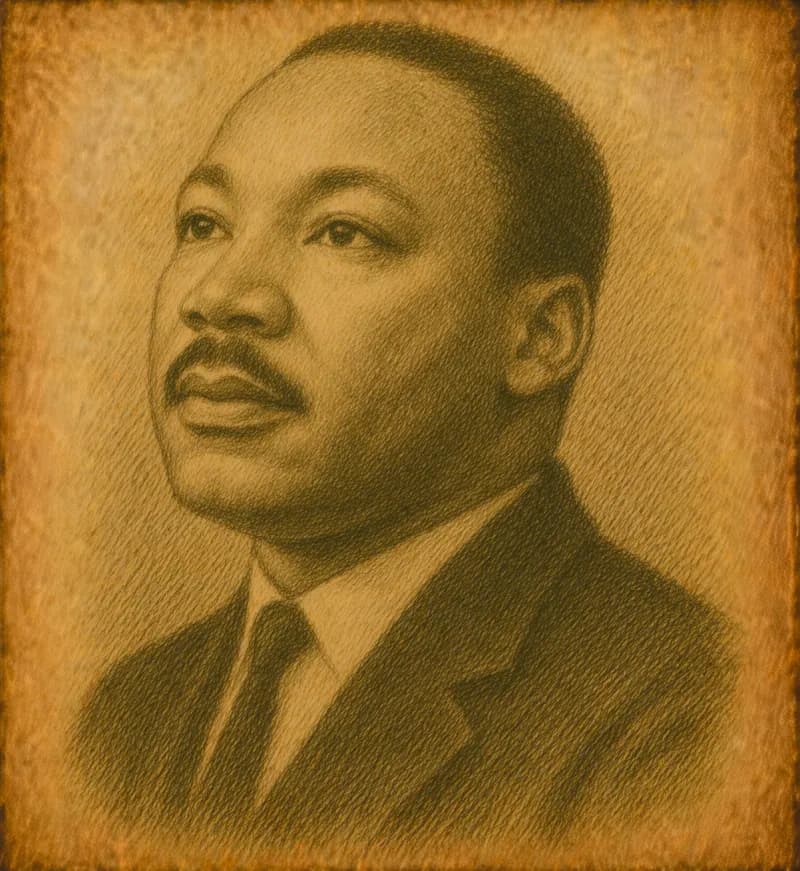
Martin Luther King Jr.
Martin Luther King Jr.
Civil Rights Leader & Minister
SECTION I -- SUBJECT PROFILE
| Name | Martin Luther King Jr. |
|---|---|
| English | Martin Luther King Jr. |
| Nationality | United States |
| Lifespan | 1929–1968 |
| Gender | Male |
| Century | 20th C. |
| Field | Politics |
| Title | Civil Rights Leader & Minister |
SECTION II -- OVERVIEW
Martin Luther King Jr.was born in 1929 in Atlanta, Georgia, into a world where Jim Crow segregation governed daily life.His father was the pastor of Ebenezer Baptist Church, and young Martin grew up surrounded by hymns, preaching, and the cadences of African-American oratory, but also by the searing everyday humiliation of the color line.
As a boy he was close to a white neighborhood playmate until the age of six, when the boy's family told him they could no longer play together because he was Black.The memory seared into him the cruelty and irrationality of racism.
A brilliant student, he entered Morehouse College at only fifteen and soon chose the ministry, entering Crozer Theological Seminary and then Boston University, where he earned a doctorate in systematic theology.The first turning point came during these years as he encountered the life and writings of Mahatma Gandhi, whose nonviolent campaign against British rule in India gave King a concrete method for fighting segregation with the moral weapon of love.
In 1954 he became pastor of Dexter Avenue Baptist Church in Montgomery, Alabama.The second turning point came in December 1955, when Rosa Parks refused to give up her seat on a segregated bus.
Still only twenty-six, King was thrust into leadership of the 381-day Montgomery bus boycott, surviving bombings, arrests, and constant threats until the Supreme Court struck down bus segregation.He co-founded the Southern Christian Leadership Conference, led campaigns in Birmingham and Selma, wrote his stirring 'Letter from Birmingham Jail,' and on August 28, 1963, standing before a quarter-million people at the Lincoln Memorial, he set aside his prepared text and improvised the 'I Have a Dream' speech.
In 1964, at thirty-five, he became the youngest person then to receive the Nobel Peace Prize, and his movement helped secure the Civil Rights Act of 1964 and the Voting Rights Act of 1965.Turning to poverty and the Vietnam War, he was shot dead on April 4, 1968, on a motel balcony in Memphis, at thirty-nine.
His birthday is now a U.S.federal holiday.
SECTION III -- CHRONOLOGY
SECTION IV -- NOTABLE STATEMENTS
“I have a dream that my four little children will one day live in a nation where they will not be judged by the color of their skin but by the content of their character.”
“Injustice anywhere is a threat to justice everywhere.”
SECTION V -- FIELD NOTES
[A]The improvised dream
The 'I Have a Dream' section was largely improvised. Gospel singer Mahalia Jackson shouted 'Tell them about the dream, Martin!' and he departed from his prepared text to deliver one of history's most iconic passages.
SECTION VI -- LEGACY & IMPACT
King's leadership of the American civil rights movement led directly to the Civil Rights Act of 1964 and the Voting Rights Act of 1965, dismantling legal segregation in the United States. His philosophy of nonviolent protest inspired movements for social justice worldwide, and his 'I Have a Dream' speech remains one of the most powerful orations in human history. Martin Luther King Jr. Day is a U.S. federal holiday.
SECTION VII -- MAJOR WORKS
- [01]'I Have a Dream' speech (1963)
- [02]Letter from Birmingham Jail (1963)
- [03]Leadership of the Montgomery Bus Boycott (1955-1956)
- [04]Selma to Montgomery marches (1965)
- [05]Nobel Peace Prize acceptance speech (1964)