SUBJECT FILE NO. IJM-0025
CLASSIFICATION: HISTORICAL ARCHIVE
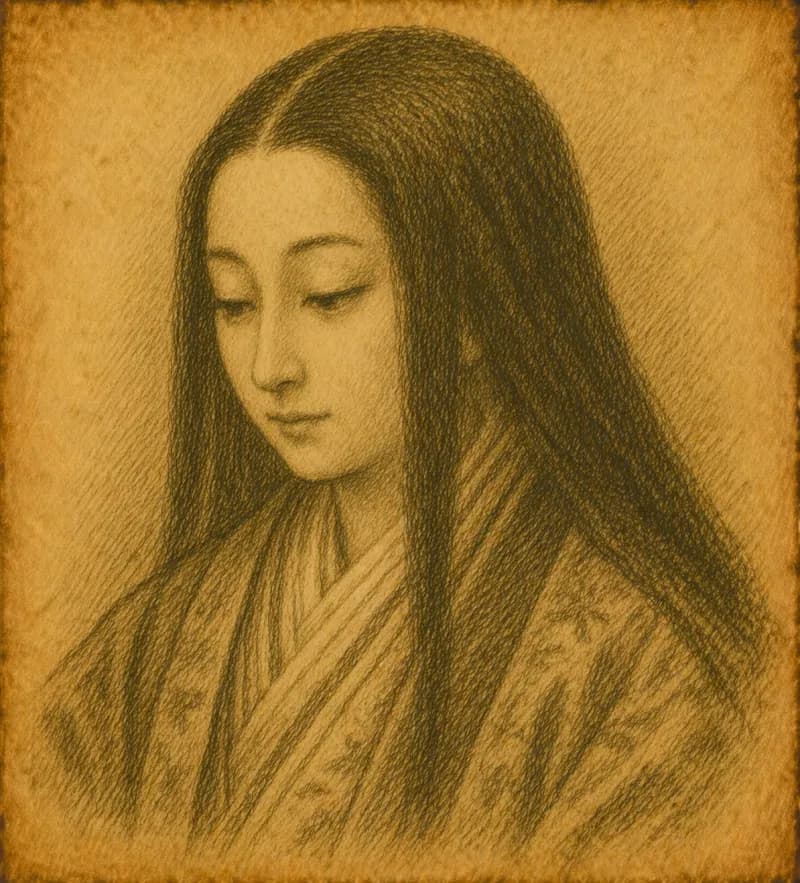
Murasaki Shikibu
Murasaki Shikibu
Novelist & Poet
SECTION I -- SUBJECT PROFILE
| Name | Murasaki Shikibu |
|---|---|
| English | Murasaki Shikibu |
| Nationality | Japan |
| Lifespan | c.973-c.1014 |
| Gender | Female |
| Century | 6th-10th C. |
| Field | Literature |
| Title | Novelist & Poet |
SECTION II -- OVERVIEW
Murasaki Shikibu was born around the year 973 in Heian-period Kyoto, into a mid-ranking branch of the powerful Fujiwara clan.Her given name has been lost to history; the name by which she is known is a nickname assembled from the heroine of her own great novel and her father's court title of shikibu-no-jo.
Her father, Fujiwara no Tametoki, was a scholar of Chinese classics who served as governor of distant provinces.As a girl, Murasaki listened from the next room as her elder brother Nobunori struggled through lessons on the Confucian classics, absorbing them herself with such speed that her father was said to lament, 'If only she had been a boy.
' It was, at the time, considered unseemly for a Heian woman to read Chinese literature openly.The first turning point came in her late twenties with her marriage to the much older Fujiwara no Nobutaka, who gave her a beloved daughter before dying in an epidemic only a few years later.
Grief-stricken, she began to write tales for her own consolation, extended stories in vernacular Japanese about an idealized prince and the women whose lives his passing touched.Word of these chapters spread through the aristocracy.
The second turning point came around 1005, when the influential regent Fujiwara no Michinaga summoned Murasaki to court to serve as a lady-in-waiting and tutor to his young daughter, Empress Shōshi, consort of Emperor Ichijō.Inside the intensely refined and claustrophobic world of the Heian court, Murasaki continued to expand her manuscript.
The Tale of Genji reached fifty-four chapters, followed the fortunes of the shining Prince Genji and then the tragic generations after him, and wove nearly eight hundred poems into a narrative that captured the impermanence and psychological depth of court life.She also left a sharp, sometimes acerbic diary that includes the earliest known critique of her rival Sei Shōnagon.
She probably died around 1014.Her Tale of Genji is widely regarded as the world's first fully developed novel, a thousand-year-old masterpiece that still shapes Japanese aesthetics.
SECTION III -- CHRONOLOGY
SECTION IV -- NOTABLE STATEMENTS
“In this world, nothing lasts forever.”
SECTION V -- FIELD NOTES
[A]Her real name is unknown
Her real name is unknown; 'Murasaki Shikibu' is a nickname derived from the heroine of her novel, Murasaki no Ue, and her father's court title of Shikibu.
SECTION VI -- LEGACY & IMPACT
Murasaki Shikibu's Tale of Genji is widely considered the world's first novel, predating European novels by centuries. Her psychological depth, narrative sophistication, and exploration of human emotion established literary standards that influenced Japanese aesthetics for a millennium. She demonstrated that women's literary voices could produce works of the highest artistic merit.
SECTION VII -- MAJOR WORKS
- [01]The Tale of Genji (c.1000-1012)
- [02]The Murasaki Shikibu Diary (c.1010)
- [03]The Murasaki Shikibu Poetry Collection (approximately 128 poems)
- [04]Contributions to Heian court literature