SUBJECT FILE NO. IJM-0037
CLASSIFICATION: HISTORICAL ARCHIVE
Michelangelo
Michelangelo
Sculptor, Painter, Architect
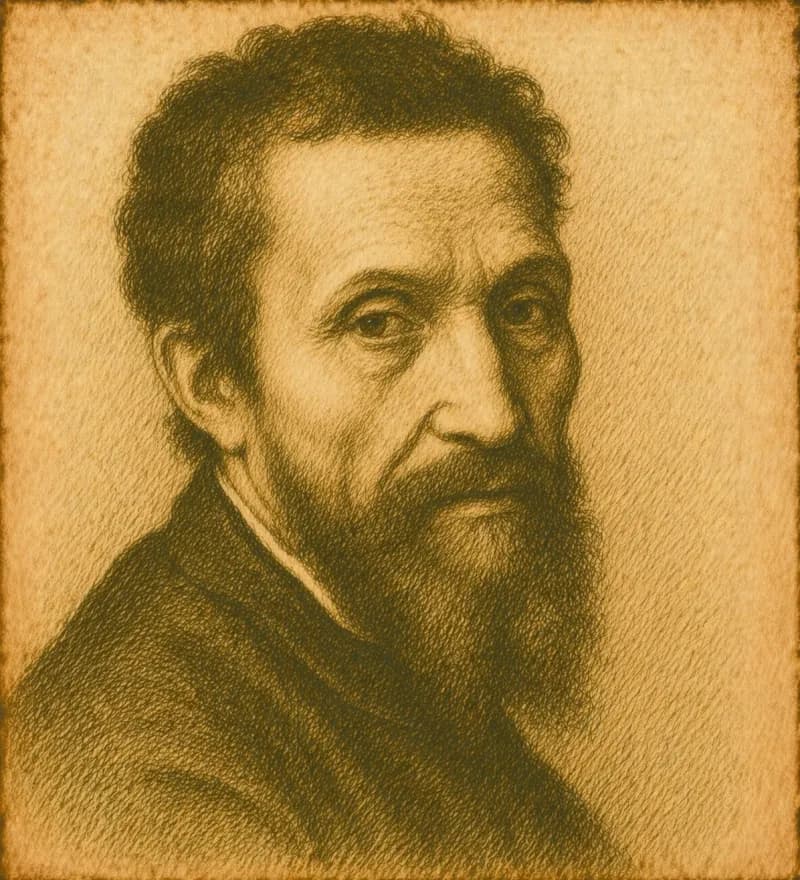
SECTION I -- SUBJECT PROFILE
| Name | Michelangelo |
|---|---|
| English | Michelangelo |
| Nationality | Italy |
| Lifespan | 1475–1564 |
| Gender | Male |
| Century | 16th–18th C. |
| Field | Art |
| Title | Sculptor, Painter, Architect |
SECTION II -- OVERVIEW
Michelangelo Buonarroti was born in 1475 in the tiny Tuscan village of Caprese, where his father Lodovico was serving briefly as the Florentine podestà.Soon after his birth the family returned to Florence, and the infant was placed with a wet-nurse in the hill town of Settignano, where her husband was a stonecutter.
Michelangelo later joked that he had drawn in marble dust 'with his mother's milk,' absorbing his sense of stone at the village quarries.His mother died when he was six, and although his father, a struggling minor aristocrat, disapproved of the trade of artist, the boy's gift was undeniable.
The first turning point came at thirteen, when he was apprenticed to the busy Florentine painter Domenico Ghirlandaio, and within a year was noticed by Lorenzo de' Medici himself, who brought him into the Medici household to study ancient sculpture in the Garden of San Marco among poets and philosophers.By his early twenties he had already carved the Bacchus and the breathtaking Pietà for St.
Peter's in Rome, in which a grieving young Virgin cradles the dead Christ across her knees.Returning to Florence, he extracted the figure of David from a block of marble that other sculptors had judged ruined, and in 1504 the seventeen-foot statue was installed as a symbol of the fledgling Republic.
The second turning point came in 1508 when Pope Julius II commissioned him to paint the ceiling of the Sistine Chapel.Michelangelo protested that he was a sculptor, not a painter, but for four years he worked on scaffolds, craning his neck upward with plaster dripping into his eyes, covering more than five thousand square feet with scenes from Genesis and monumental prophets and sibyls.
Decades later, returning to the same chapel, he painted the terrifying Last Judgment on the altar wall.In his seventies he turned to architecture and took charge of the rebuilding of St.
Peter's, designing the great dome that still defines the Roman skyline.He died in Rome in 1564 at eighty-eight, one of the most astonishing creative lives in history.
SECTION III -- CHRONOLOGY
SECTION IV -- NOTABLE STATEMENTS
“Every block of stone has a statue inside it and it is the task of the sculptor to discover it.”
“I saw the angel in the marble and carved until I set him free.”
SECTION V -- FIELD NOTES
[A]Standing, not lying down
Michelangelo painted the Sistine Chapel ceiling standing up (not lying down as commonly believed), working for four years with paint dripping into his eyes.
SECTION VI -- LEGACY & IMPACT
Michelangelo's mastery of sculpture, painting, and architecture made him the supreme artist of the Renaissance and one of the greatest creative minds in human history. The David and the Sistine Chapel ceiling set standards of artistic achievement that have never been surpassed. His architectural vision for St. Peter's Basilica defined the skyline of Rome and influenced church architecture worldwide.
SECTION VII -- MAJOR WORKS
- [01]David (1501-1504)
- [02]Sistine Chapel ceiling (1508-1512)
- [03]The Last Judgment, Sistine Chapel (1536-1541)
- [04]Pieta (1498-1499)
- [05]Dome of St. Peter's Basilica (designed 1547)