SUBJECT FILE NO. IJM-0027
CLASSIFICATION: HISTORICAL ARCHIVE
Marie Antoinette
Marie Antoinette
Queen of France
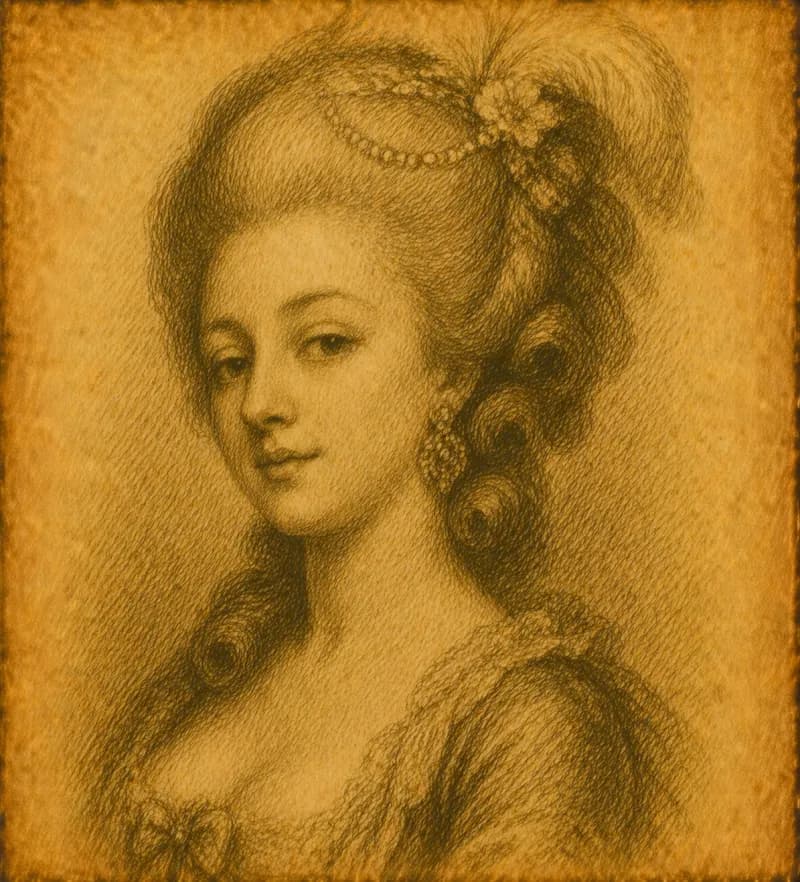
SECTION I -- SUBJECT PROFILE
| Name | Marie Antoinette |
|---|---|
| English | Marie Antoinette |
| Nationality | France |
| Lifespan | 1755-1793 |
| Gender | Female |
| Century | 16th-18th C. |
| Field | Politics |
| Title | Queen of France |
SECTION II -- OVERVIEW
Marie Antoinette was born in 1755 in Vienna as Maria Antonia, the fifteenth child of the formidable Habsburg empress Maria Theresa and the Holy Roman emperor Francis I.She grew up at the Schönbrunn Palace in a vast, warm family surrounded by music, dance, and pet dogs, with only a light education and a tendency toward social charm rather than study.
Her mother, obsessed with the balance of power in Europe, saw her youngest daughters as marriage pawns for diplomacy.The first turning point came in 1770, when the fourteen-year-old Maria Antonia was sent across the border to seal the Franco-Austrian alliance through marriage to the dauphin Louis, future Louis XVI.
At the Île aux Épis in the Rhine she was stripped of everything Austrian, dressed in French clothes, and handed over to her new country as Marie Antoinette.She found the Bourbon court at Versailles stifling in its rigid etiquette and her shy, awkward young husband unable for years to consummate the marriage.
To distract herself she threw extravagant parties, ordered elaborate gowns and feathered coiffures, gambled at high stakes, and built the rustic hamlet at the Petit Trianon where she played at country life.To a France suffering under high taxes and food shortages she became 'Madame Déficit' and 'the Austrian.
' The second turning point came in 1785 with the Affair of the Diamond Necklace, an elaborate con in which she was in fact innocent but was publicly implicated.Her reputation never recovered.
When the Revolution erupted in 1789, the royal family was forced from Versailles to the Tuileries in Paris.A disastrous attempt to flee in 1791, known as the flight to Varennes, destroyed the last shred of monarchical credibility.
Imprisoned with her children after the fall of the Tuileries in 1792, stripped of her title, separated from her son, and subjected to a savage show trial, she was guillotined on October 16, 1793, at thirty-seven.Her last recorded words, to the executioner whose foot she accidentally stepped on, were a polite apology.
Her tragic fate continues to haunt literature, film, and popular imagination.
SECTION III -- CHRONOLOGY
SECTION IV -- NOTABLE STATEMENTS
“Courage! I have shown it for years; think you I shall lose it at the moment when my sufferings are to end?”
SECTION V -- FIELD NOTES
[A]'Let them eat cake' is a myth
The famous quote 'Let them eat cake' was never actually said by Marie Antoinette - it was attributed to her by revolutionary propaganda to portray her as callous and out of touch.
SECTION VI -- LEGACY & IMPACT
Marie Antoinette's life and execution became a powerful symbol of the excesses of monarchy and the violent consequences of revolution. Her trial and death helped define the course of the French Revolution and influenced debates about justice, monarchy, and popular sovereignty that continue to this day. Her cultural impact endures through countless portrayals in film, literature, and art.
SECTION VII -- MAJOR WORKS
- [01]Patronage of the arts at Versailles
- [02]Construction of the Petit Trianon hamlet
- [03]The Diamond Necklace Affair (1785, public scandal)
- [04]Trial testimony before the Revolutionary Tribunal (1793)
- [05]Final letter to Madame Elisabeth (1793)