SUBJECT FILE NO. IJM-0029
CLASSIFICATION: HISTORICAL ARCHIVE
Winston Churchill
Winston Churchill
Prime Minister of the UK
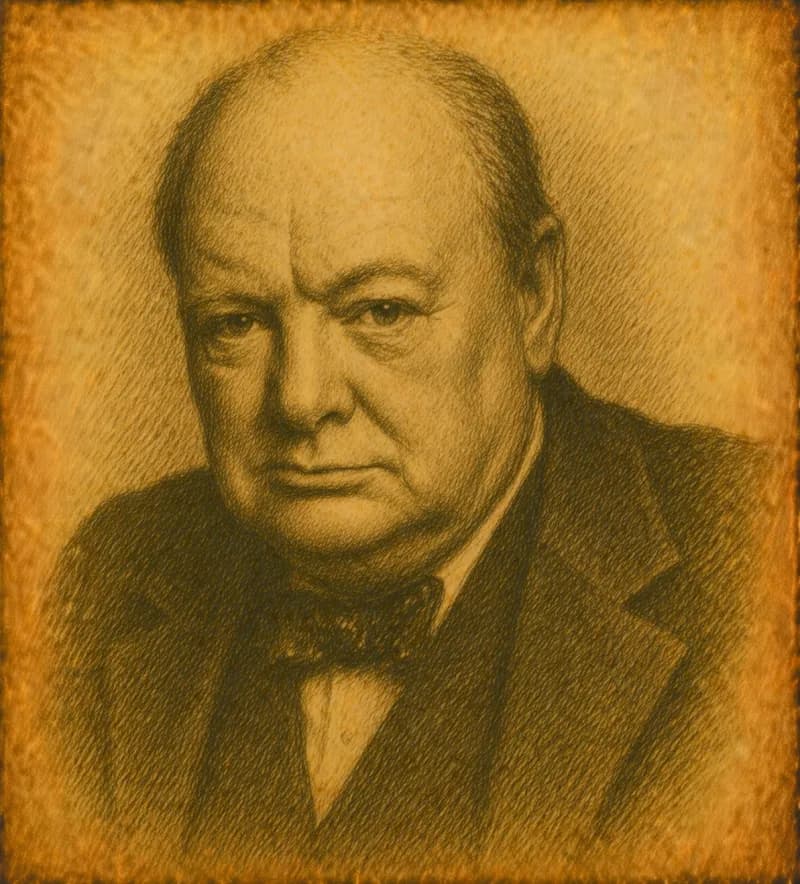
SECTION I -- SUBJECT PROFILE
| Name | Winston Churchill |
|---|---|
| English | Winston Churchill |
| Nationality | United Kingdom |
| Lifespan | 1874-1965 |
| Gender | Male |
| Century | 20th C. |
| Field | Politics |
| Title | Prime Minister of the UK |
SECTION II -- OVERVIEW
Winston Leonard Spencer-Churchill was born in 1874 at Blenheim Palace, the magnificent ducal home of his grandfather the Duke of Marlborough, into a dazzling but emotionally cold aristocratic family.His father, Lord Randolph Churchill, was a brilliant Tory politician with little time for his son, and his American mother, the stunning Jennie Jerome, was preoccupied with London society.
Sent away to boarding schools where he was unhappy and often punished, Winston proved an indifferent student in everything except history and English literature.The first turning point came when, after three attempts, he passed into the Royal Military College at Sandhurst and became a cavalry officer.
Over the next few years he saw action on the North-West Frontier of India, in Sudan at the Battle of Omdurman, and in South Africa during the Boer War, where he was captured as a war correspondent and escaped in a sensational journey that made him a national hero at twenty-six.He entered Parliament in 1900 and rose swiftly through both Conservative and Liberal ranks, serving as First Lord of the Admiralty during the First World War, where the disastrous Gallipoli campaign of 1915 forced his resignation and nearly ended his career.
The 1930s were his political wilderness, mocked for his relentless warnings about the rearmament of Nazi Germany.The second, defining turning point came in May 1940, when, as the German blitzkrieg overran Europe, King George VI asked the sixty-five-year-old Churchill to form a government.
Over the following year he rallied Britain with speeches of austere, thunderous eloquence, pledging 'blood, toil, tears, and sweat,' promising 'we shall fight on the beaches,' and declaring 'this was their finest hour.' With Roosevelt and Stalin he shaped the Grand Alliance that defeated Hitler.
Voted out of office in 1945, he returned as Prime Minister in 1951 and, improbably, won the Nobel Prize in Literature in 1953.A lifelong sufferer of what he called his 'black dog' depression, he painted more than five hundred landscapes as therapy.
He died in 1965 at ninety and was given a state funeral.
SECTION III -- CHRONOLOGY
SECTION IV -- NOTABLE STATEMENTS
“We shall fight on the beaches... we shall never surrender.”
“Success is not final, failure is not fatal: it is the courage to continue that counts.”
SECTION V -- FIELD NOTES
[A]Over 500 paintings as a hobby
Churchill painted over 500 paintings as a hobby, once saying it was the only thing that kept him sane during his 'black dog' depressions.
SECTION VI -- LEGACY & IMPACT
Churchill's wartime leadership and soaring oratory rallied Britain and the Allied nations during their darkest hours, making him indispensable to the defeat of Nazi Germany. His speeches -- 'We shall fight on the beaches,' 'Their finest hour' -- defined the spirit of resistance and remain touchstones of democratic resolve. He also shaped the post-war world order through conferences at Yalta and Potsdam.
SECTION VII -- MAJOR WORKS
- [01]'We Shall Fight on the Beaches' speech (1940)
- [02]'Their Finest Hour' speech (1940)
- [03]The Second World War (six-volume history, 1948-1953)
- [04]A History of the English-Speaking Peoples (four volumes, 1956-1958)
- [05]Nobel Prize in Literature (1953)