SUBJECT FILE NO. IJM-0035
CLASSIFICATION: HISTORICAL ARCHIVE
Himiko
Himiko
Queen of Yamatai
SECTION I -- SUBJECT PROFILE
| Name | Himiko |
|---|---|
| English | Himiko |
| Nationality | Japan |
| Lifespan | c.170–c.248 |
| Gender | Female |
| Century | 1st–5th C. |
| Field | Politics |
| Title | Queen of Yamatai |
SECTION II -- OVERVIEW
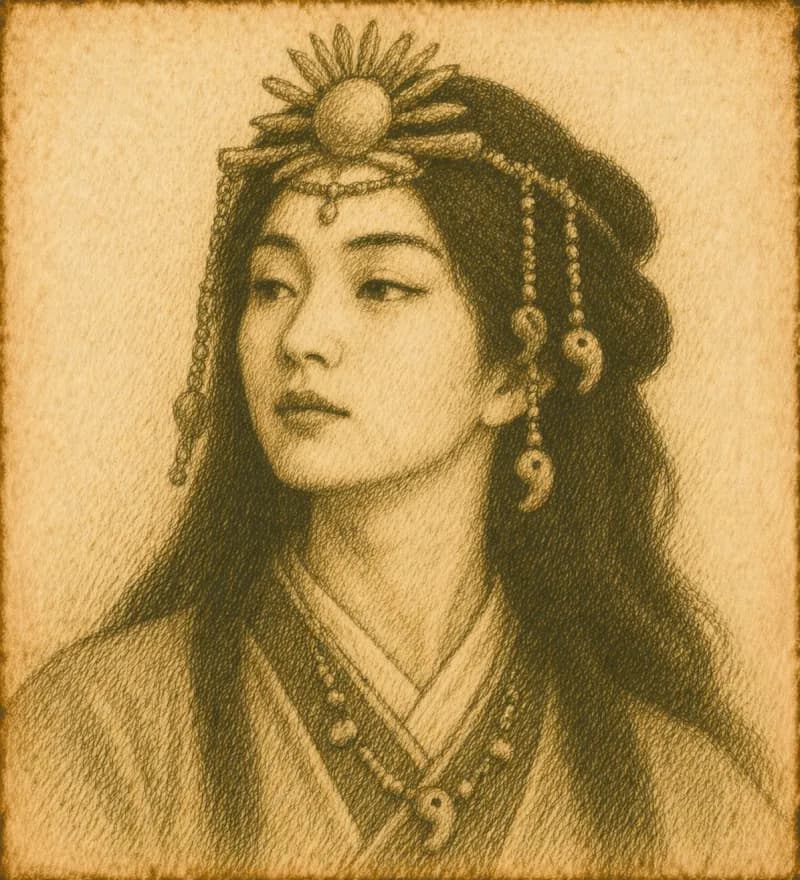
Himiko was born around the year 170 somewhere in the islands of what is now Japan, in the late Yayoi period when small agricultural chiefdoms were beginning to coalesce into larger polities.Virtually everything known about her comes from a brief passage in the Chinese historical work known as the Wei Zhi, the Records of Wei.
Her own name, the name of her kingdom, Yamatai, and even her true appearance remain the subject of fierce scholarly debate, for no contemporary Japanese source survives.Her early decades fell within a time of chronic warfare.
The Wei Zhi tells that the Wa, as the Chinese called the people of the Japanese islands, had once been ruled by a male king, but civil war had raged for years.The first turning point came around 189, when the leaders of perhaps thirty allied communities, exhausted by the 'great disturbance of the Wa,' agreed to install as their common sovereign a young woman famed for her mastery of 'the way of the demons,' a form of shamanistic ritual that allowed her to mediate between the human and spirit worlds.
Thus Himiko became queen of Yamatai.She ruled, according to the Chinese account, from a heavily guarded palace surrounded by stockades and watchtowers, attended by a thousand female servants, and saw almost no one.
Only one man was permitted to serve her food and convey her words, and her younger brother acted as her public spokesman and political manager.The second turning point came in 238, when Himiko sent the ambassador Nashonmi to the Wei court at Luoyang.
The Wei emperor received the embassy warmly and in 239 bestowed on her the title 'Queen of Wa, Friend of Wei' along with a gold seal with purple ribbon and a hundred bronze mirrors.She died around 248, reportedly while at war with the neighboring kingdom of Kuna.
A vast burial mound was raised for her and more than a hundred attendants were said to have been buried with her.The location of Yamatai remains Japan's most famous archaeological mystery.
SECTION III -- CHRONOLOGY
SECTION IV -- NOTABLE STATEMENTS
“The Wei Zhi chronicles describe her as one who「bewitched the people through sorcery」.”
SECTION V -- FIELD NOTES
[A]The queen no one could see
According to Chinese records, Himiko had 1,000 female attendants and was served by a single male who delivered her food and messages. She was rarely seen by anyone.
SECTION VI -- LEGACY & IMPACT
Himiko is the earliest named ruler in Japanese history recorded in foreign sources, making her essential to understanding Japan's origins as a political entity. The mystery surrounding Yamatai's location continues to drive archaeological research in Japan, and Himiko has become a cultural icon representing ancient Japan's connection to the Asian continent and the role of women in early Japanese leadership.
SECTION VII -- MAJOR WORKS
- [01]Unification of Yamatai through spiritual authority (c.189)
- [02]Diplomatic mission to Wei dynasty China (238)
- [03]Receipt of the gold seal 'King of Wa, Friend of Wei'
- [04]Establishment of tributary relations with the Wei court
- [05]Governance through shamanic ritual (described in Wei Zhi)