SUBJECT FILE NO. IJM-0036
CLASSIFICATION: HISTORICAL ARCHIVE
Abraham Lincoln
Abraham Lincoln
16th President of the United States
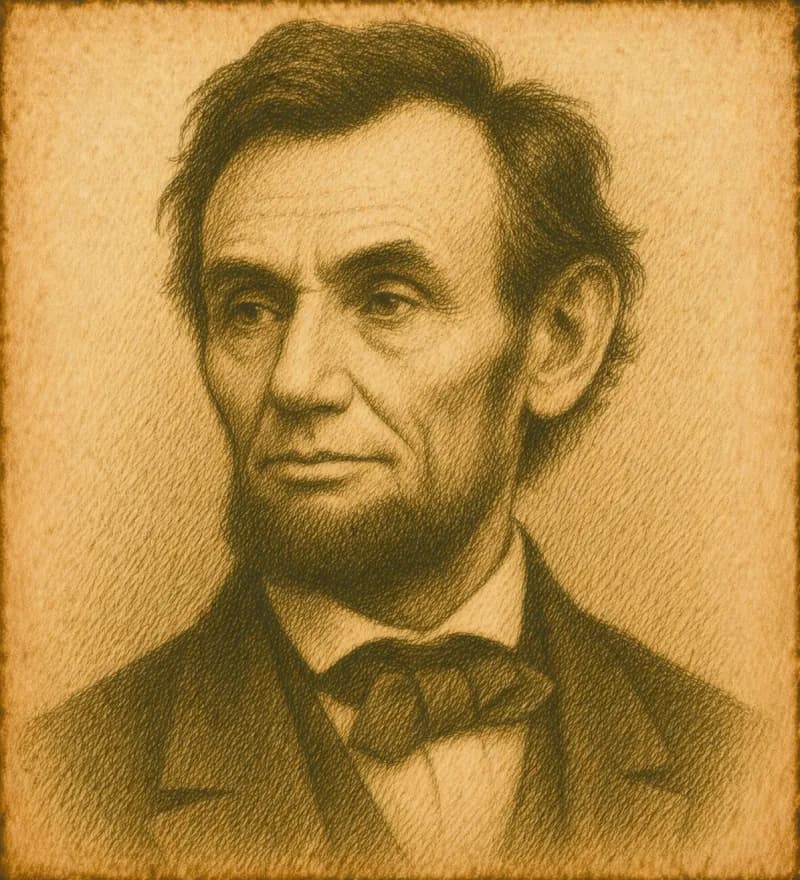
SECTION I -- SUBJECT PROFILE
| Name | Abraham Lincoln |
|---|---|
| English | Abraham Lincoln |
| Nationality | United States |
| Lifespan | 1809–1865 |
| Gender | Male |
| Century | 19th C. |
| Field | Politics |
| Title | 16th President of the United States |
SECTION II -- OVERVIEW
Abraham Lincoln was born in 1809 in a single-room log cabin on Sinking Spring Farm in Hardin County, Kentucky, the son of Thomas Lincoln, a barely literate carpenter and farmer, and Nancy Hanks Lincoln.The family drifted from Kentucky to the rougher frontier of Indiana, where nine-year-old Abraham lost his mother to a disease called milk sickness.
His stepmother, Sarah Bush Johnston, encouraged his unusual hunger for books, and the lanky boy walked miles to borrow volumes of Aesop, the Bible, and Parson Weems's Life of Washington, reading by firelight.His formal schooling amounted to less than a year.
As a young man he worked as a river flatboatman on the Mississippi, a store clerk, a postmaster, a land surveyor, and a captain of volunteers in the Black Hawk War.The first turning point came when, settling in the Illinois town of New Salem, he taught himself law from Blackstone's Commentaries and in 1836 was admitted to the bar.
Over the next two decades he built a thriving legal practice in Springfield, argued before the state supreme court, and served four terms in the Illinois legislature and one in the U.S.
House, quietly honing his gift for plain, precise, and morally clear prose.The second, historic turning point came in 1858 during his U.S.
Senate campaign against the Democrat Stephen Douglas.Their seven Lincoln-Douglas debates on the expansion of slavery made Lincoln a national figure even in defeat, and in 1860 he won the presidency as the candidate of the young Republican Party.
Seven Southern states seceded before he could even take office, and the attack on Fort Sumter in April 1861 plunged the country into civil war.He held the Union together by argument, by patience, and by an iron will, issued the Emancipation Proclamation on January 1, 1863, delivered the Gettysburg Address later that year, and signed the Thirteenth Amendment abolishing slavery.
Five days after Confederate surrender at Appomattox, he was shot at Ford's Theatre in Washington by John Wilkes Booth and died on April 15, 1865, at fifty-six.
SECTION III -- CHRONOLOGY
SECTION IV -- NOTABLE STATEMENTS
“Government of the people, by the people, for the people, shall not perish from the earth.”
“In the end, it's not the years in your life that count. It's the life in your years.”
SECTION V -- FIELD NOTES
[A]A self-made lawyer
Largely self-educated, Lincoln walked miles to borrow books and taught himself law by reading Blackstone's Commentaries.
SECTION VI -- LEGACY & IMPACT
Lincoln preserved the United States as a single nation through the Civil War and abolished slavery through the 13th Amendment, fundamentally redefining American freedom and equality. His Gettysburg Address articulated the democratic ideals that continue to inspire nations worldwide. He is consistently ranked as one of the greatest American presidents.
SECTION VII -- MAJOR WORKS
- [01]Emancipation Proclamation (1863)
- [02]Gettysburg Address (1863)
- [03]13th Amendment to the Constitution (1865)
- [04]Leadership through the Civil War (1861-1865)
- [05]Lincoln-Douglas Debates (1858)