SUBJECT FILE NO. IJM-0039
CLASSIFICATION: HISTORICAL ARCHIVE
Coco Chanel
Coco Chanel
Fashion Designer
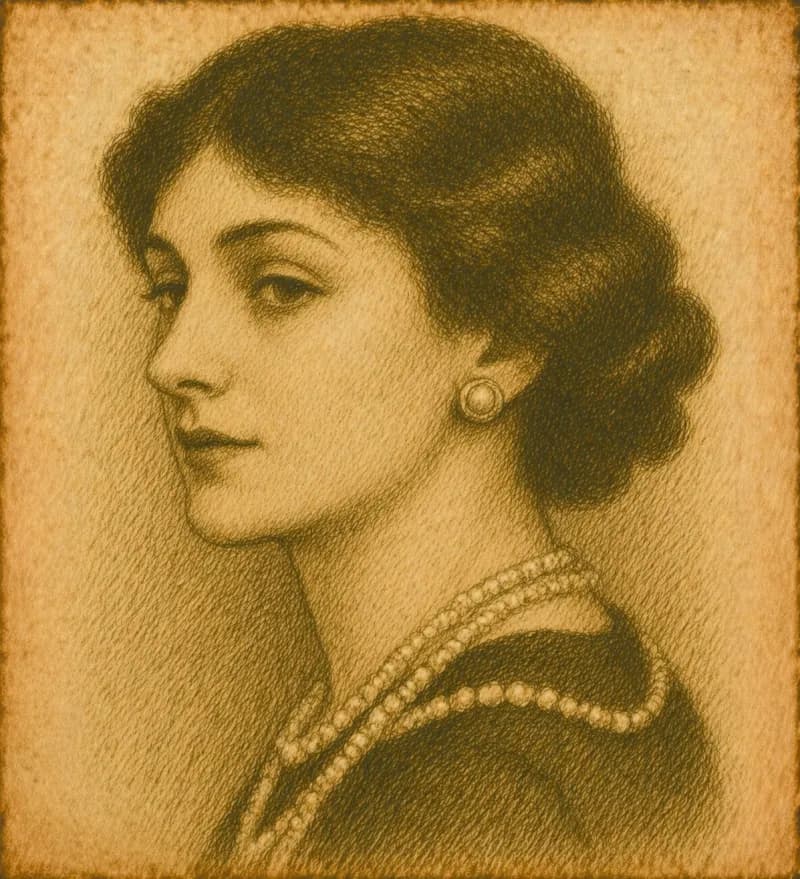
SECTION I -- SUBJECT PROFILE
| Name | Coco Chanel |
|---|---|
| English | Coco Chanel |
| Nationality | France |
| Lifespan | 1883–1971 |
| Gender | Female |
| Century | 20th C. |
| Field | Art |
| Title | Fashion Designer |
SECTION II -- OVERVIEW
Gabrielle Bonheur Chanel was born in 1883 in an almshouse in the French town of Saumur, the second child of Albert Chanel, an itinerant peddler, and Jeanne Devolle, a washerwoman who had followed him around the countryside.When Gabrielle was eleven her mother died of tuberculosis, and her father, unwilling or unable to care for his children, deposited her and her two sisters at the convent orphanage of Aubazine in the Corrèze.
For the next six years she lived in that severe stone monastery, dressed in the nuns' stark white and black and eating at long refectory tables under bare crosses.The convent's austere geometry and its uniform of simple clean lines would, paradoxically, return as the aesthetic foundation of her later work.
The first turning point came at Aubazine, where the nuns taught her to sew with meticulous skill.At eighteen she found work in a draper's shop in Moulins and sang nights in local cafés, where soldiers christened her with the nickname Coco.
A wealthy cavalry officer, Étienne Balsan, became her protector, and through him she met the cultivated English polo-playing industrialist Arthur Capel, called Boy, the love of her life, who financed her first millinery shop in Paris in 1910.The second turning point came during the First World War, when Chanel, working in seaside Deauville and Biarritz, shocked fashionable women by cutting jersey, a fabric previously used for men's undergarments, into simple, supple, sporty dresses.
Freed from the corset, women could breathe, walk, and drive cars.In 1921 she launched Chanel No.5, the first perfume to carry a couturier's name and the first to use synthetic aldehydes, and in 1926 American Vogue christened her black jersey sheath the 'little black dress,' a garment that every woman should own.
Over the following decades she added the tweed cardigan suit, costume jewelry as art, and the quilted 2.55 handbag.After a wartime eclipse, she relaunched her house at seventy-one in 1954 and worked until her death in 1971 at eighty-seven in her suite at the Ritz.
SECTION III -- CHRONOLOGY
SECTION IV -- NOTABLE STATEMENTS
“Fashion fades, only style remains the same.”
“A girl should be two things: classy and fabulous.”
SECTION V -- FIELD NOTES
[A]From orphanage to fashion empire
Raised in an orphanage after her mother died, Chanel learned to sew from nuns - the skill that would change the fashion world forever.
SECTION VI -- LEGACY & IMPACT
Chanel liberated women from the constraints of corseted fashion, introducing comfortable, elegant clothing that reflected the modern woman's active lifestyle. Her brand innovations -- the little black dress, the Chanel suit, Chanel No. 5 -- became permanent fixtures of fashion vocabulary. She proved that fashion could be both functional and luxurious, establishing a design philosophy that remains the foundation of modern womenswear.
SECTION VII -- MAJOR WORKS
- [01]Chanel No. 5 perfume (1921)
- [02]The little black dress (1926)
- [03]Chanel tweed suit (1920s-1950s)
- [04]Introduction of jersey fabric in women's fashion
- [05]Chanel 2.55 quilted handbag (1955)