SUBJECT FILE NO. IJM-0038
CLASSIFICATION: HISTORICAL ARCHIVE
Ernest Hemingway
Ernest Hemingway
Novelist & Journalist
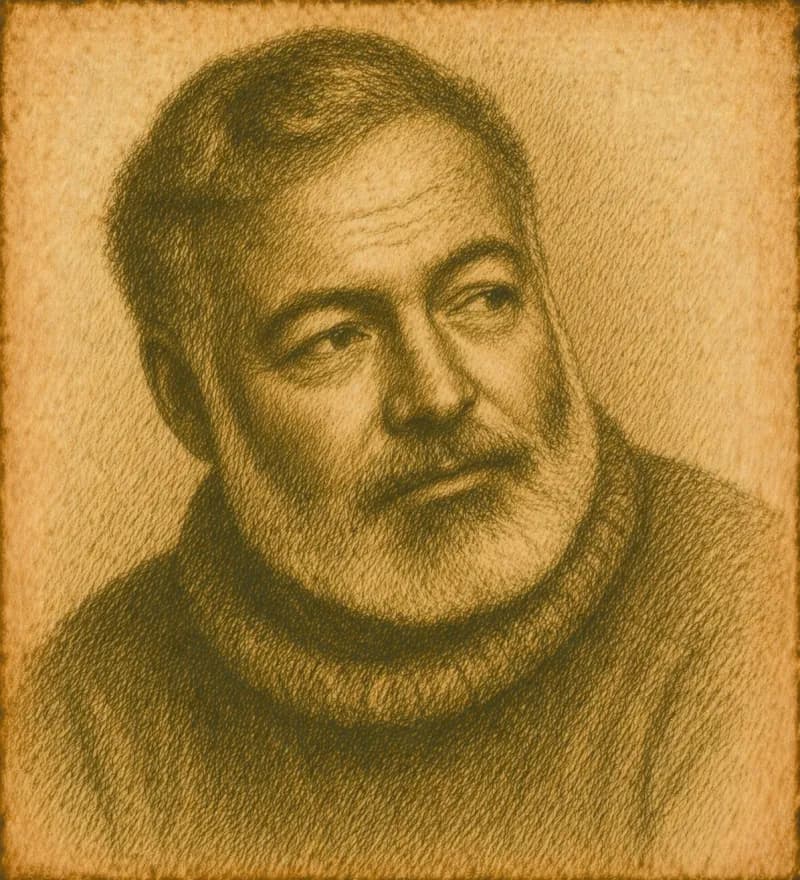
SECTION I -- SUBJECT PROFILE
| Name | Ernest Hemingway |
|---|---|
| English | Ernest Hemingway |
| Nationality | United States |
| Lifespan | 1899–1961 |
| Gender | Male |
| Century | 20th C. |
| Field | Literature |
| Title | Novelist & Journalist |
SECTION II -- OVERVIEW
Ernest Miller Hemingway was born in 1899 in Oak Park, a prosperous suburb of Chicago, the second of six children of a physician father and a musician mother.The summers of his childhood were spent at Windemere Cottage on Walloon Lake in northern Michigan, where his father taught him to fish, hunt, and identify birds with the same precision he brought to medicine.
These northwoods summers gave Hemingway the outdoor sensibility that threads through his fiction.Instead of going to college, he took a job straight out of high school as a cub reporter at the Kansas City Star.
The first turning point came in those months at the Star, whose famous style sheet urged short sentences, vigorous English, and the avoidance of adjectives.That discipline became the foundation of his prose.
In 1918, only eighteen, he volunteered as a Red Cross ambulance driver on the Italian front and, while distributing chocolate to soldiers in a trench near Fossalta, was hit by an Austrian mortar shell, receiving more than two hundred shrapnel wounds.The long recovery in a Milan hospital, and his futile love for a slightly older American nurse, Agnes von Kurowsky, seeded A Farewell to Arms a decade later.
The second turning point came in the 1920s, when he moved to Paris with his first wife Hadley as a foreign correspondent for the Toronto Star.Befriended and tutored by Gertrude Stein and Ezra Pound, he polished his craft in cafés and boxing gyms and in 1926 published The Sun Also Rises, which spoke for what Stein called a 'Lost Generation.
' Masterpiece followed masterpiece: A Farewell to Arms, For Whom the Bell Tolls set during the Spanish Civil War, and finally The Old Man and the Sea in 1952.He invented what he called the 'iceberg theory,' leaving most of a story's meaning submerged beneath a spare surface.
In 1954 he received the Nobel Prize in Literature.Dogged by injuries from two African plane crashes, deepening depression, and alcoholism, he took his own life in 1961 at his Idaho home at sixty-one.
SECTION III -- CHRONOLOGY
SECTION IV -- NOTABLE STATEMENTS
“All you have to do is write one true sentence.”
“The world breaks everyone and afterward many are strong at the broken places.”
SECTION V -- FIELD NOTES
[A]Reading his own obituaries
In 1954, Hemingway survived two consecutive plane crashes in Africa. Newspapers around the world published his obituary, and he had the rare experience of reading his own death notices.
SECTION VI -- LEGACY & IMPACT
Hemingway's spare, declarative prose style revolutionized modern fiction and influenced generations of writers worldwide. His 'iceberg theory' of writing -- showing only the surface while the deeper meaning lies beneath -- became one of the most influential literary techniques of the 20th century. His exploration of courage, loss, and human dignity under pressure defined a new literary sensibility.
SECTION VII -- MAJOR WORKS
- [01]The Old Man and the Sea (1952)
- [02]A Farewell to Arms (1929)
- [03]The Sun Also Rises (1926)
- [04]For Whom the Bell Tolls (1940)
- [05]Nobel Prize in Literature (1954)