SUBJECT FILE NO. IJM-0045
CLASSIFICATION: HISTORICAL ARCHIVE
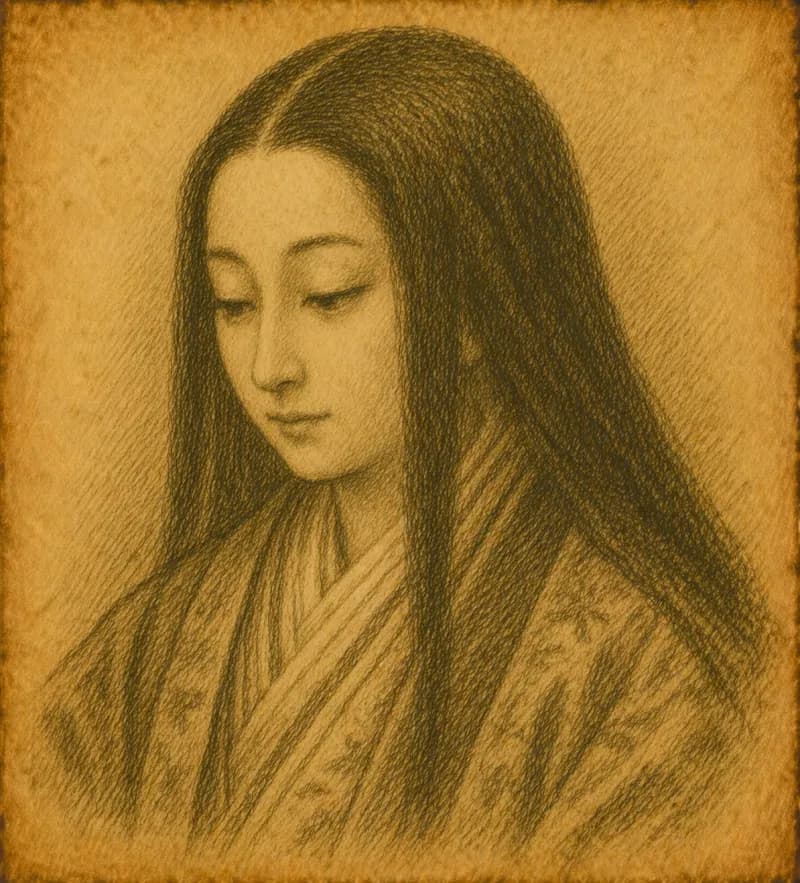
Sei Shonagon
Sei Shonagon
Court Lady & Essayist
SECTION I -- SUBJECT PROFILE
| Name | Sei Shonagon |
|---|---|
| English | Sei Shonagon |
| Nationality | Japan |
| Lifespan | c.966–c.1017 |
| Gender | Female |
| Century | 6th-10th C. |
| Field | Literature |
| Title | Court Lady & Essayist |
SECTION II -- OVERVIEW
Sei Shonagon was born around the year 966 into the Kiyohara clan, a family of middle-ranking aristocrats famous for their erudition in classical Chinese poetry.Her father Kiyohara no Motosuke was himself a distinguished poet and one of the compilers of the imperial anthology Gosen Wakashu, and he gave his unusually clever daughter an education in the classics that was rarely extended to women of her time.
She grew up absorbing not only the Japanese waka tradition but also the Chinese learning that was normally the preserve of male scholars, a combination that would give her writing its distinctive wit.The first turning point came around the year 993, when she was summoned into service at the imperial palace as lady-in-waiting to the young Empress Teishi, the favored consort of Emperor Ichijo.
The empress's salon became the most brilliant in the capital, a world of incense, poetry contests, and subtle flirtations conducted across screens of state, and Sei Shonagon quickly distinguished herself with her quick tongue and her ability to cap a Chinese couplet as deftly as any courtier.For roughly a decade she lived in the center of this dazzling world.
Her second turning point came with the sudden collapse of her mistress's fortunes.Empress Teishi's powerful father died in 995, her brothers were exiled, and in 1000 she herself died in childbirth at the age of twenty-four.
Sei Shonagon, stricken and suddenly without a patron, retreated from court life and began shaping the private notebooks she had kept during her years of service into the work now known as Makura no Soshi, The Pillow Book.Completed around 1002, it was unlike anything that had come before: a mosaic of lists, anecdotes, and aesthetic judgments, opening with the immortal line, 'In spring, the dawn—when the slowly paling mountain rim is tinged with red...
' Her later years are obscure; she is believed to have lived quietly, perhaps in reduced circumstances, and to have died around 1017.The Pillow Book established the zuihitsu or 'following-the-brush' genre that has shaped Japanese prose for a thousand years, and her rivalry with her contemporary Murasaki Shikibu, author of The Tale of Genji, remains one of the great literary pairings in world history.
SECTION III -- CHRONOLOGY
SECTION IV -- NOTABLE STATEMENTS
“In spring, the dawn—when the slowly paling mountain rim is tinged with red...”
“Someone you love whose ways are not like those of other people—that is one of the things that stir the heart.”
SECTION V -- FIELD NOTES
[A]Rivalry with Murasaki Shikibu
In her own diary, Sei Shonagon's fellow court writer Murasaki Shikibu dismissed her as intolerably pleased with herself and too eager to parade her Chinese learning. The enmity between the two defining female voices of Heian literature has fascinated readers ever since.
SECTION VI -- LEGACY & IMPACT
Sei Shonagon pioneered the zuihitsu genre of miscellaneous essays that has shaped Japanese prose for more than a thousand years. The Pillow Book remains a treasure of world literature, a record of Heian aesthetics whose acute perception and lightness of touch have never been surpassed.
SECTION VII -- MAJOR WORKS
- [01]The Pillow Book (Makura no Soshi, c.1002)
- [02]Lists of 'things that...' (catalog entries)
- [03]Poetry in Kokin Wakashu style
- [04]Court observations on Heian aesthetics
- [05]Fragmentary waka attributed to her